YOUR DRIVE, EXPLAINED
Arena Knockout: the complete guide
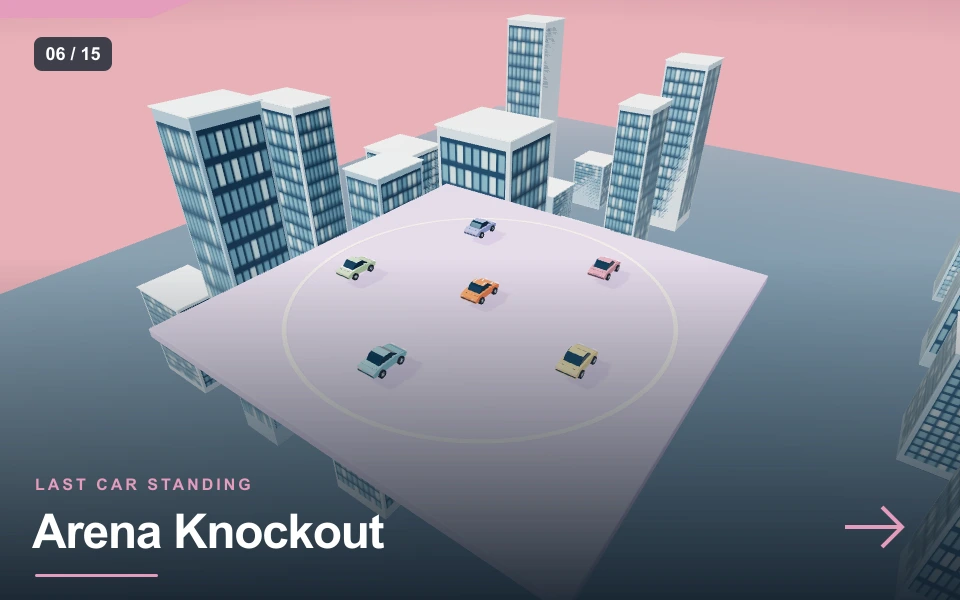
Arena Knockout is a rooftop survival contest against five pursuing cars. Use positioning, momentum and short boost bursts to send rivals beyond the physical edge while keeping your own vehicle on the roof. The central painted circle is a visual reference; the playable rooftop is square. All five rivals must fall away before the two-minute timer ends, and your own fall ends the attempt.
| At a glance | Game details |
|---|---|
| Objective | Knock five rival cars off the rooftop arena while staying on it yourself. |
| Distinct mechanic | Impact + positioning |
| Session limit | 120 seconds |
| Control style | arena |
Controls & how to play
| Input | Action |
|---|---|
| W / ↑ | Accelerate |
| S / ↓ | Brake; keep holding to reverse |
| A / D | Steer |
| Space | Use regenerating boost |
| R / Recovery | Reset to the recovery point without spending a life or adding a time penalty |
| P / Pause | Pause or resume the active session |
Choose Low, Medium or High in the player. Low starts with calmer settings; High uses the base challenge described below. Changing difficulty starts a fresh run. Start and focus the canvas for keyboard controls; touch actions appear beneath it. You have three lives. A detected failure offers Continue, and Reset vehicle restores a safe position.
Five rivals and one physical roof
Your car starts near the middle of a square elevated arena. Five rival cars begin around it and move toward your position. There is room to steer around them, but the roof has no enclosing wall to prevent a ring-out. The RING-OUTS display counts rivals that have fallen far enough below the playing surface.
Completing the mission means eliminating all five while remaining on the roof. A rival temporarily crossing the decorative circle is not eliminated, and a contact alone does not produce a ring-out. The actual outer roof edge is the boundary that removes support. You have 120 seconds. Unlike the other rooftop games, falling yourself ends this attempt immediately rather than granting several checkpoint recoveries. Keeping your own exit path in mind is therefore part of every offensive move.
Use pursuit to choose where contact happens
The rivals chase your car instead of following a lap route. Moving your position can draw them toward a side of the arena or into an approach that gives you room to turn away. Remaining in the crowded centre can create several simultaneous impacts that are difficult to predict.
Begin by making a short arc across open floor and watching which rival reaches you first. Aim to meet one opponent on a useful angle while other cars remain farther away. The rivals are physical bodies, so they can collide with one another as well as with your car. Their motion is programmed pursuit rather than a human reading your strategy. You can use that consistency to prepare an approach, but do not assume that the same car will be isolated if another collision changes its position before you arrive.
A useful strike needs a safe exit
An outward-facing contact near an edge can send a rival away with less work than repeatedly pushing it in the middle. Before committing, ask where your own car will go after impact. A straight boost toward the edge can knock the rival out and carry you off immediately after it, which loses the attempt.
Choose enough room to brake or steer back after contact. A glancing strike can redirect the rival while leaving you an angled exit across the roof. A head-on collision can reduce forward motion but also expose you to another pursuing car. Neither pattern is guaranteed: the response depends on the bodies' positions and velocities at contact. The broad roof allows tactical movement, but the edge is unforgiving. The best opening is one that combines a plausible ring-out with a car position you can still control afterward.
Boost is a limited impact resource
Space spends a regenerating boost reserve and increases the acceleration you can build into a strike. The BOOST meter shows how much remains. Releasing lets it recover. Use normal throttle to move into position, then spend a short burst once the contact line is useful.
Repeatedly holding boost while circling makes the car harder to stop near an edge and can leave the reserve low when an opportunity appears. Braking before a second strike can be more valuable than accelerating through a poor first one. There is no separate attack button, bumper weapon or temporary damage shield in this mode. The offensive effect comes from physical movement. A rival’s heavier-looking visual parts do not represent a hidden armour upgrade system. All five belong to the same small pursuit encounter, and every elimination still needs an actual fall from the roof.
Understand the square edge and delayed elimination
The circular marking is decoration on top of a square physical floor. You can drive beyond that circle while remaining supported. Use the outer surface edge as the ring-out boundary rather than trying to keep every wheel inside the paint. There is no invisible circular elimination wall.
A rival needs to descend below the rooftop region before its ring-out counts. If an opponent is falling and the counter has not changed yet, give it time rather than following it over the edge. A car that slides outward but retains support can return to the pursuit. Keep checking your remaining opponents after an elimination, because the open space and collision traffic have changed. The final ring-out ends the mission. Remaining time contributes to the result, but a high-speed move that sends you off cannot be repaired by previously earned eliminations.
Recovery and collision simulation limits
The shared R shortcut or Reset vehicle returns the car to its starting position without spending a life or adding a time penalty. It can help when the chassis is awkwardly oriented while still in play, but it is not a bonus life after a completed fall. Once the losing result appears, begin another attempt. Restart returns all five opponents to their starting positions and clears the current ring-outs.
Collision research is useful background for impact direction and momentum, but this is an arcade arena with simplified vehicles. There are no deforming panels, tyre wear, mechanical failures or repair sessions. Rival orientation and pursuit are controlled by the game. The rooftop height and stylised skyline create the setting rather than modelling a real demolition venue. The useful physical variables are support, contact direction and movement. Understanding them is more helpful than imagining hidden health bars that this game does not use.
Practise staying alive before chasing five ring-outs
Use a first attempt to circle away from the crowded centre without boost. Observe how the rivals follow and how much braking distance you need near the edge. Next, choose one approaching car and practise a short contact with a clear route back toward open floor.
Judge that practice by whether your own car remained supported. An elimination followed by your own fall is information about your exit line, not a successful technique yet. Once a safe strike becomes repeatable, add brief boost to improve its effect. After each ring-out, reposition before selecting another target. Turbo Football provides a calmer way to practise directing a separate object through contact. Pursuit Breakout keeps moving adversaries but asks you to gather access beacons and escape. Arena Knockout is the choice when the immediate outcome of each physical impact is the central challenge.
Graphics, sound and fullscreen settings
Different paint colours distinguish the five rivals from your car. A central circular marking provides an orientation reference on the square rooftop, and the city below makes the falling boundary visible. The physical floor is square; no visual ring should be mistaken for a hidden collision wall.
Sound begins after a player interaction. The shared audio system provides a synthesised engine layer, short action cues and background music. Music can be switched off separately, and volume or mute controls adjust the output. Use fullscreen for a larger view; where native fullscreen is unavailable, the expanded player keeps the scene usable. High HD increases rendering resolution and shadow detail on supported devices. Light reduces those costs on a slower phone without changing the objective. Pause before changing focus; the game also pauses when you leave the tab. Choose the setting that keeps your controls responsive rather than assuming the highest option improves the physics.
Pros & cons
What works well
- Five pursuing physics cars create changing contact situations.
- A ring-out needs an actual fall beyond the square roof.
- Boost and a safe post-impact exit reward deliberate positioning.
Practical limits
- Your own fall ends the attempt without another life.
- Opponents use programmed pursuit rather than advanced tactical AI.
- The central circle is decorative rather than the collision boundary.
Choose your next challenge
The shared player makes it easy to switch games, but each mission asks for a different decision. Compare the objective rather than expecting one score to mean the same thing across every mode.
| Game | Objective | Session |
|---|---|---|
| Arena Knockout | Knock five rival cars off the rooftop arena while staying on it yourself. | 120 sec limit |
| Turbo Football | Drive the ball past a moving goalkeeper and score three goals. | 120 sec limit |
| Pursuit Breakout | Collect three access beacons, evade the pursuit cars and reach the unlocked exit. | 120 sec limit |
Frequently asked questions
Why can a car leave the circle without being eliminated?+
The playable collision surface is a square roof. The central painted circle is a visual reference. A rival must leave the actual surface and fall below the arena before a ring-out is recorded.
Do opponents have a damage bar?+
No. This mode is about pushing physical cars off the roof, not reducing health through repeated contacts. A hard impact can still be incomplete if the rival retains wheel or body support.
Can I recover after my car falls?+
A completed fall ends the attempt immediately in this mode. The R shortcut is available during play for returning an awkwardly positioned car to the start at a time cost, but it does not grant another life after the result.
Does boost automatically knock a rival out?+
No. Boost changes your acceleration and contact momentum. Direction, location and the rival’s movement still matter. Prepare a useful line and leave room to brake or turn away after the impact.
Final words
Arena Knockout rewards a measured attempt and a clear understanding of the current mission. Start with Low, practise one section at a time and use the reset control when you need a safe position. Watch what changed between attempts before adding more speed. The useful result is a technique you can repeat, with room to improve on the next run.