YOUR DRIVE, EXPLAINED
Stunt Bowling: the complete guide
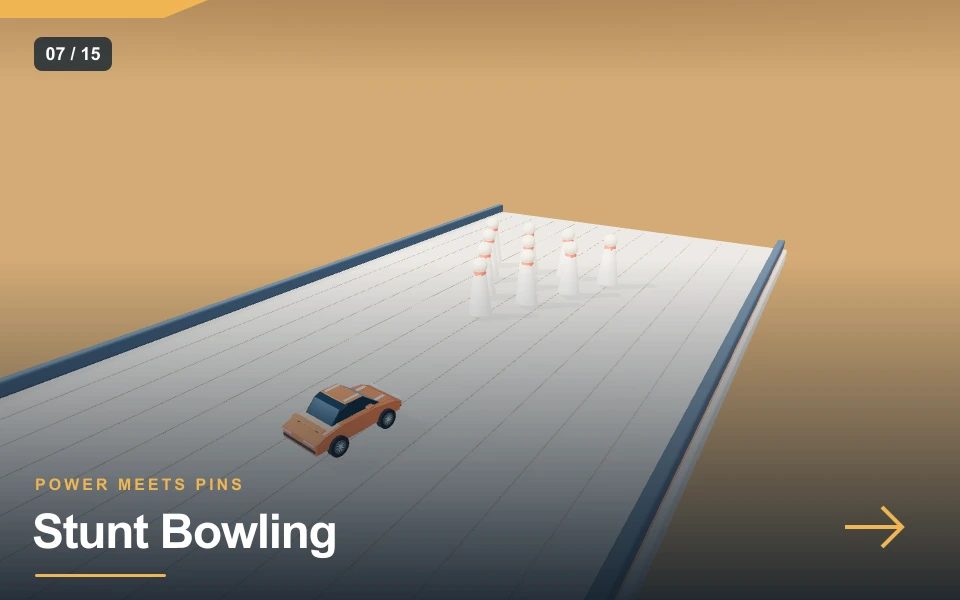
Stunt Bowling replaces ordinary driving with a launch puzzle. Aim a car down a wide bowling lane, hold to charge its power and release to send it into ten physical pins. You have three shots, and pins already knocked down remain down between them. The challenge is choosing a line for the current arrangement and enough speed to create useful secondary collisions.
| At a glance | Game details |
|---|---|
| Objective | Aim and launch your car to topple ten physical pins in three shots. |
| Distinct mechanic | Aim + launch power |
| Session limit | 150 seconds |
| Control style | bowling |
Controls & how to play
| Input | Action |
|---|---|
| A / D | Aim the launch |
| Hold then release Space | Charge power, then launch the car |
| P / Pause | Pause or resume the active session |
Choose Low, Medium or High in the player. Low starts with calmer settings; High uses the base challenge described below. Changing difficulty starts a fresh run. Start and focus the canvas for keyboard controls; touch actions appear beneath it. You have three lives. A detected failure offers Continue, and Reset vehicle restores a safe position.
Ten pins, three launches and a persistent arrangement
The pins begin in four rows: one at the front, then two, three and four farther back. The lane gives a clear view of that triangle. Your car starts at the launch end and stays in its setup position while you aim and charge. After release, it travels into the pins as a physical body.
A pin counts as down when it tilts sufficiently or falls low from its standing position. All ten must be down to complete the mission. If pins remain after a launched shot has had time to settle, an intermediate panel lets you continue to the next shot. The pins are not reset between those shots, so you can target the remaining arrangement. After three launches, an incomplete set ends the attempt. A full restart restores all ten standing pins and the original shot budget.
Aim before building the launch
A and D turn the car’s setup heading through a limited aiming range. Use small presses and inspect which part of the triangle lies down that heading. Aiming changes the physical launch direction rather than moving a separate cursor that guarantees a hit. The car itself is the projectile.
Set the line before release and avoid aiming continuously while making your final decision about power. A small angle at the start can become a substantial lateral difference by the time the car reaches the rear row. For the opening shot, compare a near-central contact with a slight offset; the secondary pin responses can differ. There is no hidden recommendation that one exact direction guarantees a strike. The bodies can bounce, spin and collide in different ways depending on their contact positions and launch momentum.
Hold, inspect power, then release
Space increases the POWER meter while held. Releasing launches the car. A short tap gives a weaker launch than a longer hold; charge caps at full rather than growing without limit. The car receives forward movement along its aimed heading and a small upward component, so the approach can include a brief airborne phase before lane contact.
This mode does not use W as the normal accelerator or Space as a regenerating boost. The custom touch controls are AIM LEFT, AIM RIGHT and HOLD / RELEASE. Once a shot is launched, the important decision has already been made and the physics determines the following collisions. You cannot steer the car around the lane like a racer to chase missed pins. Treat each shot as preparation followed by observation. If a shot misses, change the next heading or charge rather than pressing more driving buttons during the impact.
Look for chains rather than a single contact
A useful strike can knock a first pin into its neighbours and continue into the rear rows. Watch what happens after the initial impact: pins may remain standing briefly before another body reaches them. The completion check uses their actual orientation and position rather than a scripted strike animation.
The car is much heavier than an individual pin, which makes secondary collisions a central part of this deliberately unusual setup. High power can drive through a group, but it can also carry the car past a narrow opening without contacting enough pins. A line that directly meets only one pin is not necessarily bad if that contact sends it through several others. Conversely, touching a front pin does not guarantee that rear pins will fall. Read the full outcome before deciding whether power or aim was the more important weakness.
Use the next shot for what is actually left
After a shot settles, count the remaining upright pins and inspect their positions. The next launch starts from the original end, but the lane arrangement retains the earlier collisions. A later shot should address that arrangement instead of automatically repeating the first opening.
If the standing pins are mostly on one side, aim toward that side. If a narrow rear cluster remains, use the available heading carefully rather than chasing the entire original triangle. The intermediate panel pauses the active player while you continue, giving you a moment to consider the result. The overall 150-second limit is generous for three short launches, but it still ends an unfinished attempt. There is no ball-selection menu, spin slider or purchased upgrade that changes the remaining pins. The useful inputs stay intentionally small: line, held charge and release.
What is borrowed from bowling, and what is original
The ten-pin layout and the idea of clearing an arrangement provide the sport’s background. This game uses a car rather than a bowling ball and a three-shot mission rather than a regulation ten-frame scorecard. It does not award conventional strike and spare frame bonuses or claim to teach official competitive bowling scoring.
Collision physics gives the pins independent motion. Their visible bodies are stylised, and the detection of a fallen pin is tuned for this mini game. OpenStax’s discussion of collisions helps explain why contact direction and momentum affect neighbouring objects. It does not prescribe a perfect shot for this implementation. The lane walls restrict sideways movement but do not make every ricochet useful. Watch how the particular game responds, then choose another launch based on that evidence instead of assuming real bowling equipment parameters apply.
Make the three shots into a small experiment
On one attempt, keep your opening aim near the centre and use a moderate charge. Observe which row loses support first and which pins stay upright. On another, keep the charge familiar and make a small angle change. That isolates aiming as the variable and makes the outcomes easier to compare.
Within a single attempt, use the second shot for the largest remaining group and the third for a careful cleanup if available. A ten-pin finish is the primary achievement, while the result score belongs to this game’s mission rather than a conventional bowling total. Turbo Football asks you to keep repositioning around a moving ball; here the launch is chosen before the collision sequence. Cargo Balance uses loose objects in a different way, asking you to preserve them instead of toppling them. Those comparisons help select the kind of physical puzzle you prefer.
Graphics, sound and fullscreen settings
A light lane, four-row pin arrangement and contrasting neck bands make upright pins readable from the angled camera. The setup view keeps the launch direction and the current arrangement visible. Pins animate through body rotation and collision rather than playing a canned fall sequence after a scripted hit.
Sound begins after a player interaction. The shared audio system provides a synthesised engine layer, short action cues and background music. Music can be switched off separately, and volume or mute controls adjust the output. Use fullscreen for a larger view; where native fullscreen is unavailable, the expanded player keeps the scene usable. High HD increases rendering resolution and shadow detail on supported devices. Light reduces those costs on a slower phone without changing the objective. Pause before changing focus; the game also pauses when you leave the tab. Choose the setting that keeps your controls responsive rather than assuming the highest option improves the physics.
Pros & cons
What works well
- Ten independent pin bodies can collide and fall in chains.
- Aiming and held launch power replace the usual driving loop.
- Persistent pins make second and third shots meaningful cleanup decisions.
Practical limits
- There is no steering after launch.
- The three-shot mission does not reproduce regulation bowling scoring.
- A visible first contact may still leave several rear pins standing.
Choose your next challenge
The shared player makes it easy to switch games, but each mission asks for a different decision. Compare the objective rather than expecting one score to mean the same thing across every mode.
| Game | Objective | Session |
|---|---|---|
| Stunt Bowling | Aim and launch your car to topple ten physical pins in three shots. | 150 sec limit |
| Turbo Football | Drive the ball past a moving goalkeeper and score three goals. | 120 sec limit |
| Cargo Balance | Carry three loose crates through a winding harbour route and stop at the delivery pad. | 180 sec limit |
Frequently asked questions
Why does W not drive the car normally?+
This is a custom launch mode. Use A and D to aim, then hold and release Space to launch. After release, the car and pins follow physics. Normal racing throttle and steering are not active driving controls here.
Do fallen pins come back for the second shot?+
No. The existing arrangement remains during the three-shot attempt. Only the car returns to the launch end. A full restart restores all ten pins and clears the shot count.
How is a pin counted as down?+
The game checks its physical orientation and height. A sufficiently tilted or fallen pin counts; merely touching it while it remains standing is insufficient. Allow the collision sequence time to settle.
Is the score normal ten-pin bowling scoring?+
No. This is an original clear-ten-pins challenge with three launches and a mission timer. It does not reproduce a ten-frame scorecard or award regulation strike and spare frame bonuses.
Final words
Stunt Bowling rewards a measured attempt and a clear understanding of the current mission. Start with Low, practise one section at a time and use the reset control when you need a safe position. Watch what changed between attempts before adding more speed. The useful result is a technique you can repeat, with room to improve on the next run.