YOUR DRIVE, EXPLAINED
Pursuit Breakout: the complete guide
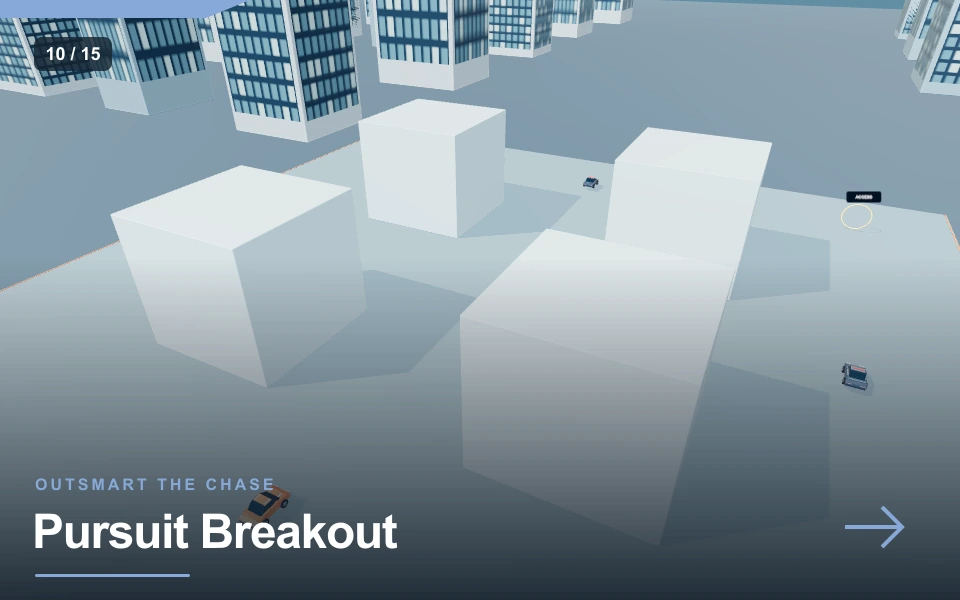
Pursuit Breakout gives you a small city arena, three access beacons and three cars that chase your position. Collect all the beacons in any order, then reach the exit while protecting your three shields. Buildings block routes for both sides, so choosing a path around the city is as important as accelerating away from a pursuer.
| At a glance | Game details |
|---|---|
| Objective | Collect three access beacons, evade the pursuit cars and reach the unlocked exit. |
| Distinct mechanic | Escape + route choice |
| Session limit | 120 seconds |
| Control style | pursuit |
Controls & how to play
| Input | Action |
|---|---|
| W / ↑ | Accelerate |
| S / ↓ | Brake; keep holding to reverse |
| A / D | Steer |
| Space | Use regenerating boost |
| R / Recovery | Reset to the recovery point without spending a life or adding a time penalty |
| P / Pause | Pause or resume the active session |
Choose Low, Medium or High in the player. Low starts with calmer settings; High uses the base challenge described below. Changing difficulty starts a fresh run. Start and focus the canvas for keyboard controls; touch actions appear beneath it. You have three lives. A detected failure offers Continue, and Reset vehicle restores a safe position.
Access comes before escape
The arena contains four solid buildings and open streets around them. Three ACCESS markers occupy different outer parts of the city. Drive near each one to collect it; the marker disappears and the access counter rises. They can be collected in any order, so your route choice is part of the mission.
The EXIT marker sits in the remaining outer corner. Reaching it before collecting all three beacons does not complete the run. After the access count reaches three, returning near that exit ends the mission if your shields remain. The 120-second countdown is shared by the whole escape. There are no passengers to load, intersection signal controls or laps to complete. The challenge combines route collection, moving pursuit and a final destination. Keep the access display visible so you know whether the next useful action is another beacon or the exit.
Use buildings to change the chase
The pursuing cars plan routes around the blocked building areas and regularly update their path toward your current position. They do not simply pass through the walls. Turning around a building can force a pursuer to take a different street, creating space for you to approach a beacon.
Look at the open corridor before making a sharp turn. A building corner can block your own path if you steer too late, leaving the chase close behind. The pursuit is programmed on a small navigation grid, not a human police strategy or a city-wide traffic simulation. It can react to your movement without predicting every future turn. You can exploit a useful separation, but you still need to drive the actual open surface. The skyline beyond the arena is decoration and does not contain extra roads or collectable access points.
Plan a loop that leaves the exit useful
The three beacons occupy the northwest, northeast and southeast outer areas, while the exit lies southwest. A broad route around the arena can gather them and return toward the exit without repeatedly cutting through the central buildings. You are free to choose the opposite direction or change the order if the pursuit blocks your intended opening.
Before accelerating, identify a route to the first beacon and an outgoing path after collection. Stopping on the marker while surrounded gives the pursuers time to close. The collection radius allows you to pass through a nearby region rather than park exactly on the ring. A beacon that has disappeared is already collected; revisiting it provides no additional access. If you change direction after a contact, recheck the remaining markers instead of automatically continuing a route that no longer suits the positions of the chasing cars.
Shields count meaningful pursuit impacts
Your car begins with three shields. A sufficiently strong contact with a pursuing car consumes one, and a short immunity interval prevents a sustained overlapping collision from draining them all instantly. The shield display is therefore a practical indicator of remaining opportunities rather than a realistic damage meter.
Breaking away after contact is still useful. Repeatedly meeting the same pursuer once the interval has ended can spend another shield. Braking, changing direction around a building or finding an open street can create distance. There are no weapons to disable the pursuers and no repair pickups in this arena. The goal is to gather access and reach the exit before the shields run out. An outward route also needs care: driving beyond the arena surface can cause a fall and waste time even if no pursuit car made the last contact.
Use boost for an open escape line
Space spends a regenerating boost reserve. A brief burst on an open street can help separate your car from a chase or carry through a beacon’s collection region. The reserve recovers after release. Use normal throttle while positioning, then boost once the next stretch has room.
Boosting directly into a building corner does not create an escape. It can leave the car stopped with pursuers approaching from behind. Begin turns early, reduce speed when the route becomes tight and accelerate once aligned with the next street. R or Reset vehicle returns the car to its starting position, restores three shields and moves the pursuers back to their openings. Collected access stays collected. There is no life cost or added time penalty; elapsed mission time stays spent. Continue offers the same safe recovery after a detected failure. Start a new run clears access and starts the whole mission again.
Read the result as a mission outcome
Collecting all access and entering the exit completes the mission. Exhausted shields or an expired timer consume a life and offer Continue while lives remain. The third failed attempt opens Play again for a fresh run. A high movement speed alone is not a completion condition. The result records mission progress, and remaining time contributes to a successful run’s score.
This mode does not offer a wanted-level system, realistic police procedures, licensed city locations or online players. It is an original short pursuit puzzle with three programmed physical opponents and four blocked buildings. General road-awareness material provides background for looking ahead and leaving room to change direction, but the fictional escape objective is not real-world driving advice. The physics is deliberately simplified for repeatable browser sessions. Your stored best belongs to this game and device, so use it to compare your own route choices rather than claiming a shared competitive ranking.
Improve one route decision per attempt
Start by collecting one beacon without boost and noting which street gives you the most space afterward. On the next attempt, keep that opening and extend toward a second beacon. If a building contact interrupts the route, move the braking or steering point earlier rather than simply trying the same turn faster.
Once all three collections are comfortable, practise the return toward the exit. Keep one useful boost burst for that final open stretch instead of draining the reserve during every early turn. Compare shield preservation and collection order as well as the final score. Velocity Coast asks for traffic gaps on a continuous highway; Arena Knockout uses pursuing cars to create ring-out opportunities. Pursuit Breakout is the choice when moving adversaries, navigation around obstacles and collecting a route prerequisite are the central decisions.
Graphics, sound and fullscreen settings
Solid city buildings, access rings and distinct pursuit cars make the small arena readable. Collected markers disappear so the remaining route prerequisites remain visible. The camera follows the player car rather than showing a large open-world map, and the shields display reports meaningful pursuit contacts.
Sound begins after a player interaction. The shared audio system provides a synthesised engine layer, short action cues and background music. Music can be switched off separately, and volume or mute controls adjust the output. Use fullscreen for a larger view; where native fullscreen is unavailable, the expanded player keeps the scene usable. High HD increases rendering resolution and shadow detail on supported devices. Light reduces those costs on a slower phone without changing the objective. Pause before changing focus; the game also pauses when you leave the tab. Choose the setting that keeps your controls responsive rather than assuming the highest option improves the physics.
Pros & cons
What works well
- Three pursuing cars update routes around solid building blocks.
- Beacons can be collected in any order, creating meaningful route choice.
- Shield immunity avoids losing every shield in one sustained contact.
Practical limits
- The city is a small arena rather than an open-world map.
- There are no weapons, repair items or wanted-level stages.
- Boost cannot rescue a route blocked by a building corner.
Choose your next challenge
The shared player makes it easy to switch games, but each mission asks for a different decision. Compare the objective rather than expecting one score to mean the same thing across every mode.
| Game | Objective | Session |
|---|---|---|
| Pursuit Breakout | Collect three access beacons, evade the pursuit cars and reach the unlocked exit. | 120 sec limit |
| Velocity Coast | Cover the greatest distance before the difficulty-adjusted timer expires while protecting your three shields. | 90 sec on High |
| Arena Knockout | Knock five rival cars off the rooftop arena while staying on it yourself. | 120 sec limit |
Frequently asked questions
Must I collect the beacons in a fixed order?+
No. Any order is accepted. Each marker disappears after collection, and the access counter tracks the three unique beacons. Choose a route that suits the current pursuit positions and leaves an escape path.
Why does reaching EXIT not finish the attempt?+
The exit requires all three access beacons first. An early visit does not satisfy the mission. Gather the remaining visible markers, then return to the exit while shields and time remain.
Do pursuers drive through buildings?+
Their navigation routes around blocked building areas, and the buildings have physical collision bodies. The pursuit uses a small periodically updated grid route rather than human strategy or an unrestricted open-world traffic system.
Can I restore shields during the run?+
There are no repair pickups. R, Reset vehicle or Continue restores three shields and resets pursuing cars while preserving collected access. Reset adds no time penalty. A full restart also clears beacons and restores the original timer and three lives.
Final words
Pursuit Breakout rewards a measured attempt and a clear understanding of the current mission. Start with Low, practise one section at a time and use the reset control when you need a safe position. Watch what changed between attempts before adding more speed. The useful result is a technique you can repeat, with room to improve on the next run.