YOUR DRIVE, EXPLAINED
Cargo Balance: the complete guide
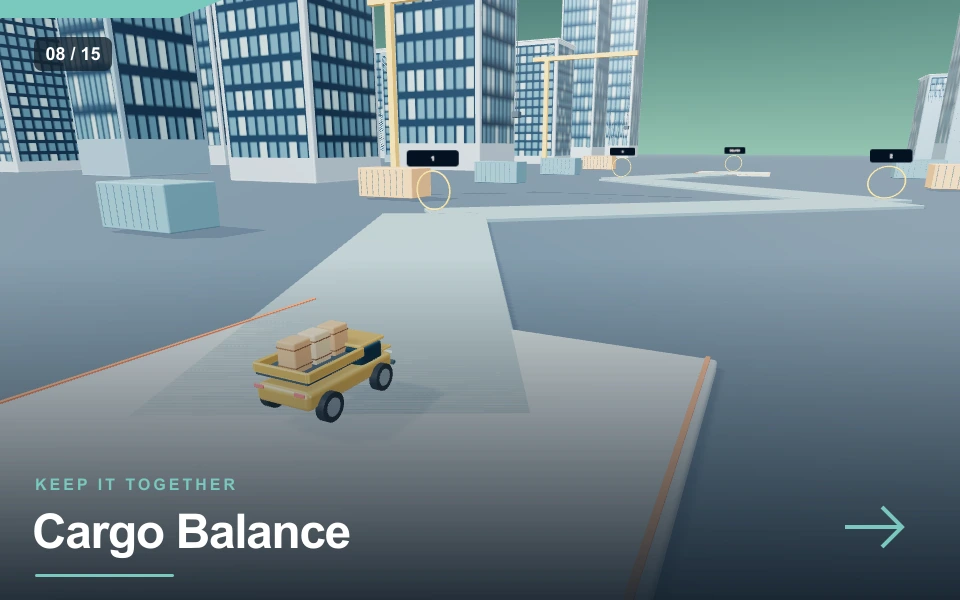
Cargo Balance is a delivery challenge built around three loose crates in a pickup bed. Guide the truck along a winding harbour route, pass four delivery points and stop at the final pad with every crate still onboard. The cargo is made of separate physics bodies, so abrupt turns or unstable movement can spill it. A careful arrival is worth more than treating the route like a highway race.
| At a glance | Game details |
|---|---|
| Objective | Carry three loose crates through a winding harbour route and stop at the delivery pad. |
| Distinct mechanic | Weight + smooth inputs |
| Session limit | 180 seconds |
| Control style | cargo |
Controls & how to play
| Input | Action |
|---|---|
| W / ↑ | Accelerate |
| S / ↓ | Brake; keep holding to reverse |
| A / D | Steer |
| R / Recovery | Reset to the recovery point without spending a life or adding a time penalty |
| P / Pause | Pause or resume the active session |
Choose Low, Medium or High in the player. Low starts with calmer settings; High uses the base challenge described below. Changing difficulty starts a fresh run. Start and focus the canvas for keyboard controls; touch actions appear beneath it. You have three lives. A detected failure offers Continue, and Reset vehicle restores a safe position.
The delivery needs the route and the load
The pickup starts on a broad pad with three crates settled in its rear bed. A winding raised road connects four marked route points around a harbour setting with cranes and containers. The first three points guide the route; the final one identifies the delivery pad. Follow them in order rather than cutting directly toward the last marker.
The CARGO display shows how many crates remain sufficiently close above the chassis, and STOPS shows route progress. Losing any crate after the opening settling interval ends the attempt. Reaching four points with an incomplete load cannot fulfil the delivery. At the final pad, remain near the destination, reduce movement to a stop and hold that position briefly. The mission gives you 180 seconds. It is a transport puzzle about preserving loose objects, not a race against traffic or a sequence of timed passenger pickups.
Learn the truck before approaching a bend
Use W to accelerate and S to brake; once forward movement has stopped, continued brake input produces reverse. The truck uses gentler acceleration and braking than the faster skyline cars. That helps the initial load settle and makes a normal departure practical. It does not mean that every turn at maximum speed is safe.
Drive a short distance on the opening pad and watch how the crates move relative to the bed. They may shift slightly while remaining onboard. The low side and end walls offer some support, but the cargo is not glued down. Return steering toward centre after a correction, and choose a route heading before developing more speed. A small lateral oscillation can become a larger cargo movement when repeated. The visible pickup bed is part of the challenge, so keep checking it alongside the next road section.
Slow before the route changes direction
The road alternates between left and right turns around the marked points. Brake on the approach while the truck is still aligned with the current section, then turn at a lower speed. Accelerate again after the chassis points down the outgoing road. This reduces sudden changes in movement that can tip or slide loose cargo.
Do not aim at a marker without inspecting the actual connecting road. The route is narrower than the start and delivery pads, and leaving the surface can remove the truck’s support even if the waypoint is nearby. A long steering hold can swing the bed out beyond the line followed by the front. There is enough time to use deliberate corners. Once you can keep all three crates through the route, remove excessive stops gradually rather than replacing the whole technique with constant full throttle.
Read cargo loss before blaming the waypoint
The boxes are independent bodies with mass, orientation and collision. They can slide against the bed, bump one another or tip beyond its low walls. The CARGO count is therefore a live physical condition, not an inventory value that changes only at a scripted obstacle. A crate that leaves the bed does not become an item you can collect again by driving over it.
If the result says a crate left the truck, look at the preceding turn and change its approach speed or steering duration. A route marker being reached at the same moment does not mean the marker caused the loss. Abrupt reverse changes can also disturb the load. The initial settling interval prevents a brief setup contact from ending a run immediately, but it is not an immunity mode for later collisions. Restart is the way to restore a complete load for a new delivery attempt.
Make the delivery stop deliberate
The final pad is wider than the winding road and sits beyond the last direction change. Approach it gently, keep near its marked centre and brake until the truck is effectively still. The completion hold is roughly a second and a half; rolling through the marker does not deliver the cargo.
If all four route points are recorded but no result appears, check speed, proximity to the pad centre and the three-crate count. A small repositioning can be useful, but avoid a sharp last-second reverse. There is no separate unloading button, crane interaction or forklift stage after parking. The mission ends when the route, preserved load and stable delivery stop are satisfied. Your best score includes the game-specific completion result and time remaining. Comparing it with a drift or football score would not measure the same skill.
Friction and inertia explain the feel
Friction background helps explain why a loose crate can remain with a moving bed during gentle movement yet shift when the truck changes direction abruptly. The objects also collide with one another and the bed’s walls, so the outcome depends on the actual arrangement during a manoeuvre. This is why small repeated corrections can feel different from one smooth turn.
The game is deliberately simpler than a freight simulator. The crates have no adjustable straps, weight-selection menu or damage percentage. The pickup has no gear management, fuel economy or mechanical repair. The harbour cranes and containers establish the setting but are not interactive loading equipment. The shared R car recovery spends time and can disrupt a loose load, so a full restart is clearer if the attempt has become unstable. Real-road load-securing requirements are not replaced by this arcade model; the guide explains this fictional delivery challenge.
A practice plan based on one corner at a time
For an opening attempt, depart slowly and concentrate on the first direction change. Watch whether the rear bed follows the road smoothly and whether the crates remain above it. Repeat with an earlier brake application while keeping the steering similar. This isolates braking as the change instead of mixing several new inputs.
Next, aim to reach two route points with all three crates and avoid worrying about the final score. Continue the same measured technique through the remaining bends, then practise the stable stop separately. Precision Parking is a useful comparison for low-speed positioning, although its bay alignment and two-second hold use different rules. Stunt Bowling uses independent physical objects for the opposite goal: deliberately making them fall. Cargo Balance is the choice when the challenge is keeping a load intact while navigating a changing route.
Graphics, sound and fullscreen settings
A yellow pickup with an open rear bed replaces the sports-car visual. Three individually visible wooden crates sit above it, with harbour containers, cranes and water around the winding road. The scenery frames the route; loading machinery is decorative rather than an interactive delivery stage.
Sound begins after a player interaction. The shared audio system provides a synthesised engine layer, short action cues and background music. Music can be switched off separately, and volume or mute controls adjust the output. Use fullscreen for a larger view; where native fullscreen is unavailable, the expanded player keeps the scene usable. High HD increases rendering resolution and shadow detail on supported devices. Light reduces those costs on a slower phone without changing the objective. Pause before changing focus; the game also pauses when you leave the tab. Choose the setting that keeps your controls responsive rather than assuming the highest option improves the physics.
Pros & cons
What works well
- Three separate crate bodies visibly respond to truck movement.
- The winding route makes acceleration, turning and braking different decisions.
- Delivery requires both the complete load and a stable final stop.
Practical limits
- A lost crate ends the attempt and cannot be recollected.
- Cranes and containers are scenery rather than loading tools.
- This is a simplified delivery model with no straps or freight upgrades.
Choose your next challenge
The shared player makes it easy to switch games, but each mission asks for a different decision. Compare the objective rather than expecting one score to mean the same thing across every mode.
| Game | Objective | Session |
|---|---|---|
| Cargo Balance | Carry three loose crates through a winding harbour route and stop at the delivery pad. | 180 sec limit |
| Precision Parking | Park inside all three highlighted bays. Stop and hold a correct position and heading for two seconds. | 180 sec limit |
| Stunt Bowling | Aim and launch your car to topple ten physical pins in three shots. | 150 sec limit |
Frequently asked questions
Are the crates attached to the pickup?+
No. They are separate physical bodies supported by the bed and its low walls. They can shift, tip or fall during movement. Keeping all three onboard is a continuous mission requirement.
Why is the run unfinished after four route points?+
The final delivery also requires staying near the pad centre, slowing below roughly walking speed and holding still briefly with all crates preserved. Passing through the marker at speed is incomplete.
Can I pick up a fallen crate again?+
There is no collection mechanic for spilled cargo. After the opening settling interval, losing any crate ends the attempt. Restart provides a fresh truck and complete load for another route.
How does it differ from parking?+
Cargo Balance evaluates a winding ordered route, loose load retention and a brief stable delivery stop. Precision Parking focuses on three bay positions, heading alignment and a two-second hold. The shared low-speed controls serve different objectives.
Final words
Cargo Balance rewards a measured attempt and a clear understanding of the current mission. Start with Low, practise one section at a time and use the reset control when you need a safe position. Watch what changed between attempts before adding more speed. The useful result is a technique you can repeat, with room to improve on the next run.