YOUR DRIVE, EXPLAINED
Skywire Drive: the complete guide
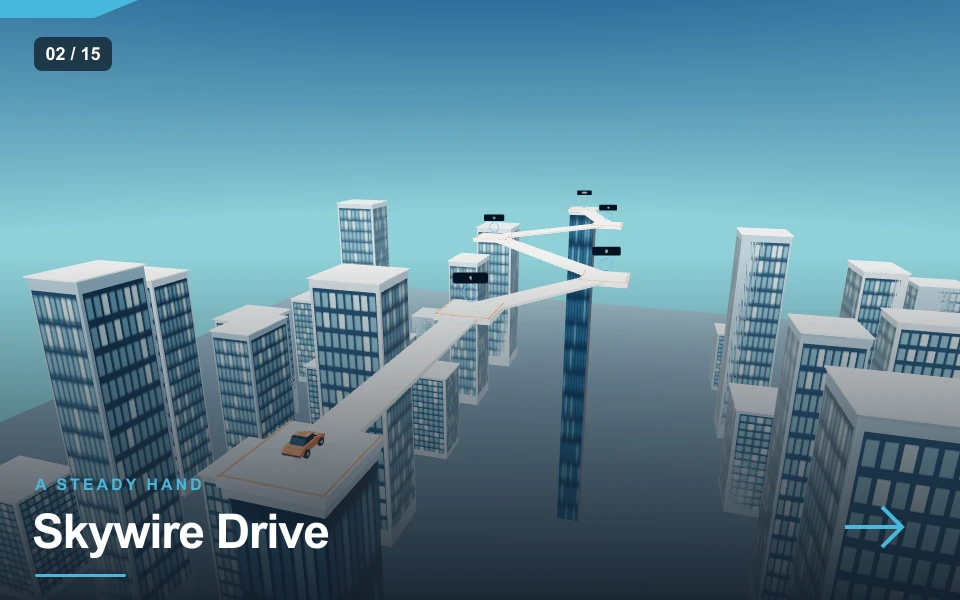
Skywire Drive places a car on a 3.2-metre suspended ribbon above the city. Follow five route points across changing bends and bring the car to a stop on the final roof. There is no jump button to rescue a badly chosen line. The challenge comes from keeping both sides of the car supported while balancing steering, braking and the temptation to rush.
| At a glance | Game details |
|---|---|
| Objective | Cross a three-metre ribbon road forty floors above the city, then stop on the final roof. |
| Distinct mechanic | Precision + nerve |
| Session limit | 180 seconds |
| Control style | wire |
Controls & how to play
| Input | Action |
|---|---|
| W / ↑ | Accelerate |
| S / ↓ | Brake; keep holding to reverse |
| A / D | Steer |
| R / Recovery | Reset to the recovery point without spending a life or adding a time penalty |
| P / Pause | Pause or resume the active session |
Choose Low, Medium or High in the player. Low starts with calmer settings; High uses the base challenge described below. Changing difficulty starts a fresh run. Start and focus the canvas for keyboard controls; touch actions appear beneath it. You have three lives. A detected failure offers Continue, and Reset vehicle restores a safe position.
A narrow route with a stopping finish
The start roof gives you a small safe area before the ribbon begins. The road then changes direction several times, running toward intermediate numbered points and finally a STOP marker on another roof. These are actual narrow collision surfaces, not a painted lane inside a broad invisible floor. Going too far sideways leaves the wheels without support.
Route progress follows the points in order. The counter helps identify which bend you have reached, but reaching the last point at speed does not complete the mission. The car must remain near the final stop zone and slow to roughly walking speed or less. Brake while you still have space on that roof. You have 180 seconds and three lives, so a measured crossing is a sensible opening target. Arriving with control matters more than an impressive speed reading.
Read the whole car against the edge
The camera follows the chassis and looks down the current driving direction. Use the road edges near the front wheels as your immediate reference, then glance farther ahead for the next turn. On a ribbon this narrow, keeping the centre of the car above the road is not enough if a wheel or the rear half swings outside it.
Short steering inputs are easier to undo than a long hold. Return the wheel toward centre as the car reaches your chosen heading, rather than continuing to steer until you see a problem. A small angle accumulates lateral movement while you keep driving forward. If you notice the car drifting toward an edge, lift the accelerator early and make a modest correction. A fast correction followed by an equally large counter-correction often creates the oscillation that sends the rear wheels off the ribbon.
Prepare for a corner before entering it
The route begins straight, then bends right, changes back across the skyline and bends again toward the destination. Look at the connecting section before the numbered point rather than treating the marker itself as a sharp steering command. The physical strips overlap at their junctions, but there is still limited room to swing a long car around.
Brake on the straight approach, turn while moving slowly and restore the accelerator only after the chassis aligns with the outgoing strip. Stopping completely is allowed; the clock keeps running, but there is no minimum continuous speed requirement. If you need to reverse, hold the brake until the forward motion ends and then continue holding to back up. Reverse steering changes the movement you see, so make particularly short adjustments. The route is a precision puzzle, and choosing a slower speed is part of solving it.
Why the last roof deserves its own plan
The final roof is wider than the ribbon, which can make the end look forgiving. Its width does not eliminate the stopping requirement or protect you from driving beyond the opposite edge. Release the accelerator as you enter, aim for the STOP area and use the brake until the speed falls. Keep the car near the marker while it settles.
If the route counter reaches five and the result has not appeared, inspect position and speed rather than searching for another numbered point. Rolling past the marker at high speed is incomplete. A gentle approach avoids the need for a rushed reverse on the roof. There is no docking animation, parking camera or hidden perfect-heading requirement here. The finish checks the completed route, proximity to the destination and low movement. Precision Parking asks for different alignment tolerances and should not be used as an exact guide to this finish.
A fall costs time as well as a life
Falling below the route consumes a life and returns the car to its most recent reached route point. Those points are useful recovery positions, but they remain on the narrow course. Pause and identify the next outgoing strip before you drive again. The recovery does not automatically rotate the vehicle into the next bend.
The R shortcut or Reset vehicle returns you to the checkpoint without spending a life or adding a time penalty. It is useful when a car is awkwardly positioned, but repeated recovery can use up a large part of the three-minute session. The entire mission restarts only when you choose a new attempt. Your best score is saved locally after a result. An intermediate route point does not become permanent progression across later restarted sessions. The personal-best number includes game-specific scoring and remaining time, so it is useful for comparing your own Skywire attempts rather than ranking unrelated vehicle games.
Steering friction in this particular game
The car uses four suspension raycasts and ground steering, with simplified grip. Ground contact is the source of useful directional control. Once the car is unsupported, turning the on-screen steering buttons cannot move a new road under it. Friction background explains why contact is necessary, but this is an arcade vehicle model rather than a road-driving simulator.
The 3.2-metre width, the skyline height and the marked route are design parameters of this original course. They are not measurements of a public road, a safety clearance recommendation or a licensing exercise. The graphics show an approximate forty-floor setting using towers and distant streets. The city is scenery: there are no enterable buildings, passengers or open-world side missions. Focus on the ribbon and the next connected section. Knowing these limits helps you distinguish a missed line from a feature the game simply does not offer.
Practise a bend, then join the route together
On the first attempt, cross only the opening straight and stop near the first turn. Experiment with a brief steering press at low speed, then observe how much heading remains after release. On a later attempt, connect that turn to the next strip without aiming for a fast finish. Repeat the same approach speed until the result becomes predictable.
For the final roof, deliberately practise braking early and arriving slowly. A finish with ample time remaining can still fail if you arrive with no stopping room. Once the whole course is repeatable, remove unnecessary full stops one at a time. Keep any stop that helps you line up a difficult bend. Rooftop Leap is the opposite kind of skyline challenge: it requires launching across empty space. Bike Trials replaces the steering ribbon with side-view balance and hops over separate rooftop pads.
Graphics, sound and fullscreen settings
Light-coloured ribbon surfaces contrast against the distant blue city. Numbered markers identify the route, and the final stop marker uses a different colour. The camera follows your current heading rather than showing a fixed overhead minimap. Read the nearby road edges before using distant scenery as a reference.
Sound begins after a player interaction. The shared audio system provides a synthesised engine layer, short action cues and background music. Music can be switched off separately, and volume or mute controls adjust the output. Use fullscreen for a larger view; where native fullscreen is unavailable, the expanded player keeps the scene usable. High HD increases rendering resolution and shadow detail on supported devices. Light reduces those costs on a slower phone without changing the objective. Pause before changing focus; the game also pauses when you leave the tab. Choose the setting that keeps your controls responsive rather than assuming the highest option improves the physics.
Pros & cons
What works well
- The road is genuinely narrow and suspended, with physical falls.
- Five changing route sections reward controlled steering.
- The stopping finish gives the final approach a distinct objective.
Practical limits
- Large steering corrections can be difficult to recover.
- Checkpoint positions still need a carefully chosen heading.
- There is no airborne jump or automatic edge protection.
Choose your next challenge
The shared player makes it easy to switch games, but each mission asks for a different decision. Compare the objective rather than expecting one score to mean the same thing across every mode.
| Game | Objective | Session |
|---|---|---|
| Skywire Drive | Cross a three-metre ribbon road forty floors above the city, then stop on the final roof. | 180 sec limit |
| Rooftop Leap | Charge a jump and land on three different skyscraper roofs. | 150 sec limit |
| Bike Trials | Balance, climb and bunny-hop across rooftop steps to the final platform. | 150 sec limit |
Frequently asked questions
Is there a hidden floor under the ribbon?+
No broad driving floor catches the car beneath the course. The visible narrow strips and roofs supply support. Falling far below the route uses a life and returns you to the latest route checkpoint.
Why is the run unfinished with five route points?+
The last roof also requires a low-speed stop near its destination zone. Finishing the route counter while moving quickly does not complete the mission. Brake and settle near the STOP marker.
Can I stop at a difficult turn?+
Yes. There is a countdown, but no rule requiring uninterrupted movement. Stopping to line up a bend is often useful while learning. You can later remove unnecessary stops to improve your own result.
How do I reverse on the narrow strip?+
Hold the brake until forward motion has ended, then keep holding to reverse. Use small steering inputs and watch the rear as well as the front. Recovery is available if the angle becomes impractical.
Final words
Skywire Drive rewards a measured attempt and a clear understanding of the current mission. Start with Low, practise one section at a time and use the reset control when you need a safe position. Watch what changed between attempts before adding more speed. The useful result is a technique you can repeat, with room to improve on the next run.