YOUR DRIVE, EXPLAINED
Bike Motocross: the complete guide
Bike Motocross trades a four-wheel driving loop for a side-view 3D dirt course with a powered rear wheel, tilting chassis and airborne hops. Climb ramps, cross the elevated dirt gap and land upright on the way to the 130-metre finish. Throttle builds gradually, braking changes the approach and lean lets you adjust the bike while it is in the air.
| At a glance | Game details |
|---|---|
| Objective | Ride the dirt jumps and land upright on your way to the 130-metre finish. |
| Distinct mechanic | Throttle + airborne lean |
| Session limit | 100 seconds |
| Control style | moto |
Controls & how to play
| Input | Action |
|---|---|
| W / GAS | Drive the rear wheel |
| S / BRAKE | Brake the rear wheel |
| A / D | Lean backward / forward |
| Space / HOP | Hop while grounded |
| P / Pause | Pause or resume the active session |
Choose Low, Medium or High in the player. Low starts with calmer settings; High uses the base challenge described below. Changing difficulty starts a fresh run. Start and focus the canvas for keyboard controls; touch actions appear beneath it. You have three lives. A detected failure offers Continue, and Reset vehicle restores a safe position.
A short course built around ramps and a gap
The route begins on level dirt before rising through several ramps and plateaus. The central raised section contains an actual missing-road gap, followed by a descending landing section. The final part returns to level ground before the finish marker. Hills, trees and trackside scenery frame the course without becoming extra interactive missions.
The objective is to reach 130 metres while upright and supported. The distance display shows how far the chassis has travelled along the course; simply passing the finish while still falling does not count as a grounded finish. There are three lives and a 100-second limit. This is a solo course rather than a race against AI riders. It uses a side-following camera to make takeoff, pitch and wheel contact readable on a desktop or phone.
Throttle turns the rear wheel rather than moving a lane marker
W drives the rear-wheel motor. The throttle response builds gradually, which makes the opening more manageable than instantly applying maximum wheel speed. S brakes the rear motor. Releasing the accelerator lets the bike coast; braking changes that movement more quickly.
The bike has two physical wheels linked to its chassis, so the slope beneath them affects its attitude. It can climb a ramp, become airborne and land with a different pitch. It is not a car-shaped cursor moving between fixed lanes. A and D apply backward or forward lean. Small presses are useful for correcting the nose; long holds can tilt too far and cost a life. On touch screens, labelled GAS, BRAKE, LEAN and HOP controls provide the same actions. There is no separate handlebar left-right steering plane to manage in this side-view course.
Prepare for a ramp with a useful approach speed
The first ramps let you learn how a slope changes the bike’s pitch. Stay on the accelerator long enough to reach the rise, then watch the front wheel and chassis as they climb. A short lift or brake application before an awkward landing can be more useful than holding throttle without observing the course.
The powered wheel can affect attitude as the bike leaves support. Lean lets you bring the chassis back toward an upright landing, with some passive stabilisation to keep ordinary movement approachable. That assistance does not turn every input into a safe landing. A strong backward lean can raise the front too far; a strong forward lean can send it nose-down. Keep the balance display and visual bike angle in agreement when you practise. The interesting decision is the combination of speed, slope and lean, not just reaching a new distance number.
The dirt gap rewards a timed hop
Space adds an upward hop while the bike has wheel contact and its short cooldown has recovered. The raised gap carries a HOP THE GAP marker near the takeoff area. Use the hop before the wheels leave the supporting ramp, and maintain enough forward movement to cross into the next section.
Holding the button can trigger another hop when contact and cooldown permit, so a brief press and release makes a deliberate launch easier to judge. There is no unlimited midair jump. If the bike has already fallen into the opening, the button cannot manufacture support below it. The ramp itself can also create airborne movement, which means speed and slope still matter even before you add a hop. Watch the landing section and avoid using every rise as a cue for maximum backward lean. The useful goal is returning both wheels to a stable line.
Recoveries keep progress within an attempt
Tilting too far over or falling well below the route consumes a life. A Continue panel pauses the mission; choosing Continue returns the bike to a supported course checkpoint with brief protection. Time remains paused at the panel, and elapsed course time stays spent. Checkpoints are reached while supported rather than being granted just because a falling bike passed a horizontal coordinate.
Three exhausted lives end the attempt. An expired countdown consumes a life and offers Continue with a refreshed timer. The restart button restores the whole course opening. R or Reset vehicle returns to the checkpoint without spending a life or adding a time penalty. After recovery, use a measured throttle to inspect the slope beneath the wheels before building speed again. Your saved best is a result from this browser, not a globally ranked motocross time. A finish with fewer incidents is useful evidence of control, even if it is slower than an aggressive attempt that never reached the final grounded marker.
A motocross-inspired mini game with clear limits
Motocross background describes off-road motorcycle competition, terrain and jump-related skills. This original game takes the visible dirt-ramp theme and the need to balance throttle with landing attitude. Its physics and controls are deliberately simplified for short browser play.
There is no gear shifting, clutch input, suspension tuning, licensed circuit or realistic rider injury. The bike is constrained to the side-view movement plane while the scenery and model render in 3D. Its physical wheels and hinge-linked body still respond to contact, and lean affects the chassis, but this is not training for riding an actual motorcycle. Projectile-motion and torque references provide context for the airborne arc and angular movement. They do not predict an exact perfect run. Treat the course as a learnable fictional challenge with clear support, hop and recovery rules.
Practise the gap after learning one landing
Use the first attempt to climb the initial rise without adding a hop. Observe whether the chassis returns level on the descent, then use a small lean correction on a later attempt. Once that response is familiar, practise a hop from grounded dirt and compare the extra flight time it creates.
At the elevated gap, release the hop button after takeoff and watch the next surface. If the front reaches it while the rear falls short, adjust the departure point or approach speed rather than leaning backward continuously. When the gap is repeatable, carry a calmer line through the remaining hills toward the finish. Bike Trials offers separate rooftop pads with slower movement and five deliberate short hops. Rooftop Leap uses a car’s charged launch instead of wheel-motor balance. Motocross is the option for a flowing dirt route with slopes and an airborne gap integrated into the course.
Graphics, sound and fullscreen settings
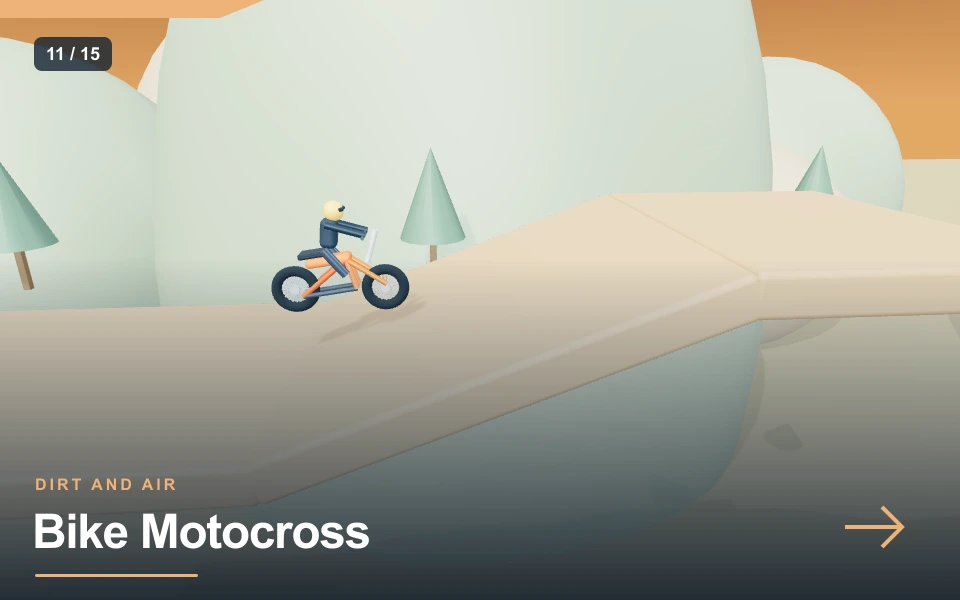
The 3D bike has visible tyres, spokes, frame and a rider model. Dirt ramps, hills and trees define the setting, with a labelled raised gap. The side-view camera keeps the wheels and pitch readable; it does not expose unrestricted lateral steering merely because the scene renders in three dimensions.
Sound begins after a player interaction. The shared audio system provides a synthesised engine layer, short action cues and background music. Music can be switched off separately, and volume or mute controls adjust the output. Use fullscreen for a larger view; where native fullscreen is unavailable, the expanded player keeps the scene usable. High HD increases rendering resolution and shadow detail on supported devices. Light reduces those costs on a slower phone without changing the objective. Pause before changing focus; the game also pauses when you leave the tab. Choose the setting that keeps your controls responsive rather than assuming the highest option improves the physics.
Pros & cons
What works well
- A powered rear wheel and tilting chassis make movement visibly physical.
- Ramps and a real elevated gap change takeoff and landing decisions.
- A side-view camera makes touch balance controls readable.
Practical limits
- Movement is constrained to a side-view plane within the 3D scene.
- Excessive lean costs a life rather than enabling unlimited flips.
- There are no opponent riders, gear changes or suspension upgrades.
Choose your next challenge
The shared player makes it easy to switch games, but each mission asks for a different decision. Compare the objective rather than expecting one score to mean the same thing across every mode.
| Game | Objective | Session |
|---|---|---|
| Bike Motocross | Ride the dirt jumps and land upright on your way to the 130-metre finish. | 100 sec limit |
| Bike Trials | Balance, climb and bunny-hop across rooftop steps to the final platform. | 150 sec limit |
| Rooftop Leap | Charge a jump and land on three different skyscraper roofs. | 150 sec limit |
Frequently asked questions
Is this a 3D bike game or a flat sprite game?+
The bike, wheels, course and scenery are rendered as 3D geometry. Gameplay is constrained to a side-view movement plane so throttle, pitch and landings stay readable. It does not offer free-direction motorcycle steering.
Can I hop while falling?+
The hop requires wheel support and an available cooldown. Press before leaving the takeoff surface. Once unsupported inside a gap, holding the button cannot create a fresh midair jump.
Why did the finish not count in the air?+
The car-free course uses a grounded finish: the bike must reach 130 metres while supported. Passing that distance during a fall is incomplete. Settle onto the final dirt section and continue upright.
How does it differ from Bike Trials?+
Motocross follows sloped dirt ramps with a central airborne gap and a 130-metre finish. Trials uses slower movement over separate elevated rooftop pads, with five planned short hops and a 91-metre finish.
Final words
Bike Motocross rewards a measured attempt and a clear understanding of the current mission. Start with Low, practise one section at a time and use the reset control when you need a safe position. Watch what changed between attempts before adding more speed. The useful result is a technique you can repeat, with room to improve on the next run.