YOUR DRIVE, EXPLAINED
Bike Trials: the complete guide
Bike Trials is a slow precision course across six separate rooftop pads. The heights rise and fall, and real gaps interrupt the route. Use a powered rear wheel, short grounded hops and measured lean to reach the 91-metre finish. Unlike the flowing dirt ramps in Motocross, each rooftop asks you to prepare a departure, clear its edge and settle before the next move.
| At a glance | Game details |
|---|---|
| Objective | Balance, climb and bunny-hop across rooftop steps to the final platform. |
| Distinct mechanic | Balance + short hops |
| Session limit | 150 seconds |
| Control style | trials |
Controls & how to play
| Input | Action |
|---|---|
| W / GAS | Drive the rear wheel |
| S / BRAKE | Brake the rear wheel |
| A / D | Lean backward / forward |
| Space / HOP | Hop while grounded |
| P / Pause | Pause or resume the active session |
Choose Low, Medium or High in the player. Low starts with calmer settings; High uses the base challenge described below. Changing difficulty starts a fresh run. Start and focus the canvas for keyboard controls; touch actions appear beneath it. You have three lives. A detected failure offers Continue, and Reset vehicle restores a safe position.
Six pads make five separate crossing decisions
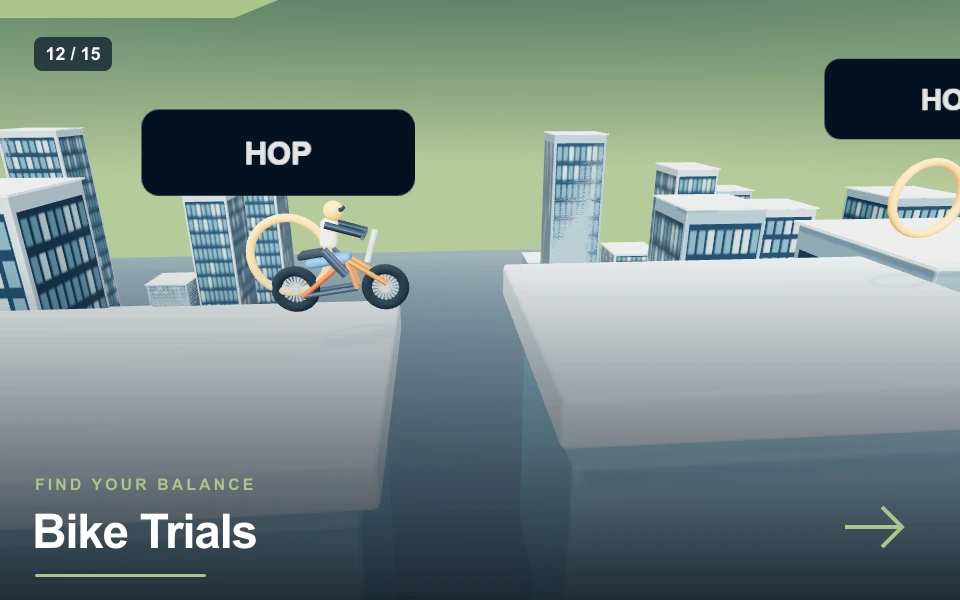
The route begins on a broad rooftop pad. The next three pads climb in small height steps, and the last two descend toward the finish. Empty gaps separate them. Those openings have no continuous driving ramp, so simply holding the accelerator eventually takes the bike off support or into a raised face.
The finish sits at 91 metres on the last pad. You must reach it upright and grounded. There are three lives and a 150-second limit, leaving room to study the edges and make deliberate departures. The DISTANCE and BALANCE displays help identify your current position and attitude. This is a side-view route rather than a free-roaming rooftop map. The camera tracks along the course, letting you see the next gap and the bike’s front-to-rear angle without managing a separate camera control.
The slower motor gives you preparation time
W powers the rear wheel and builds throttle gradually. The Trials motor is slower than the Motocross motor, which makes each short gap easier to judge. S brakes, while A and D apply backward or forward lean to the chassis. Space produces a grounded hop when its cooldown is ready.
Use a short acceleration phase to approach the departure area rather than creeping right to the edge and jumping without forward speed. A stationary hop rises but does not carry across the opening. Too much speed can consume the safe preparation space and leave no wheel support when you press. The slower tuning is deliberate: it gives room to combine movement and a hop before the lip. Touch labels match these actions, so the same preparation works with on-screen controls. Lean changes attitude rather than steering the bike into another lateral lane.
Hop before the wheels lose the roof
The HOP markers sit near departure areas. Press Space while grounded and carry movement toward the next pad. The upward impulse is tuned for the short gaps and height steps of this route. There is a cooldown, so several rapid taps do not create an unlimited series of launches.
Release after the hop so the next one is a deliberate action. Holding can produce another hop once support and cooldown permit, which is harder to judge on a small pad. If the bike rolls off before launching, waiting until the front wheel is already below the next lip is too late. On a raised destination, leave enough flight to bring both wheels above the near edge. A front-wheel brush against the wall can tilt the chassis without creating a stable landing. Aim for surface contact inside the pad rather than touching its face.
A landing should leave room for the next departure
The first three gaps climb onto higher surfaces. The fourth and fifth descend, giving a longer potential fall before support returns. Those different heights mean that copying one hop timing unchanged across all five openings is not the most reliable plan. Watch where the wheels arrive and adjust the next departure accordingly.
After contact, use a small lean correction and brake if you need to settle before the following edge. The bike includes passive balance assistance, but held lean can still tilt too far. A long backward hold after clearing a raised lip may create a rear-heavy landing, while a strong forward hold can drive the nose into the next surface. Keep corrections brief and observe the chassis. The final pad is wider, yet completion still needs grounded support at the finish distance. An airborne pass above that point does not end the course successfully.
Checkpoint recovery is different from a new attempt
Reaching a pad while supported records a recovery point for that active run. If the bike tips too far or falls well below the route, one life is spent and a Continue panel pauses play. Continue returns it a little inside the reached pad and briefly protects the landing. Time stays paused while you choose, and elapsed course time remains spent.
R or Reset vehicle also restores the bike to its supported checkpoint without a life or time penalty. Use Start a new run for a completely fresh opening. A restart clears the current checkpoints and restores the lives and timer. A coordinate reached while falling does not create a safe future pad checkpoint. Watch for genuine wheel support before assuming the next recovery is secured. The remaining-life display is useful when deciding whether to continue practising a later gap or start over and rehearse a smoother opening.
Trials-inspired balance without pretending to teach riding
Motorcycle trials background emphasises precise movement through obstacles, which informs this game’s slower pacing and separate pad decisions. The virtual course is simpler: it has a rear-wheel motor, a hinge-linked chassis, lean input and a hop, with no clutch, gear selection or rider body-position simulation beyond the visible model.
The scene renders in 3D, but the bike’s movement is confined to the side-view plane. That prevents the camera and lateral balance from obscuring the short-gap puzzle on a phone. Physical wheel contact still matters, and angular movement can change a landing. Torque and projectile-motion references explain the general ideas behind tilt and flight, while this implementation uses its own tuned gravity and impulses. It is not a training guide for jumping a real motorcycle or navigating a real rooftop. Evaluate it by its fictional controls and the visible consequences they produce.
A practical sequence for mastering the route
Start with the first gap alone. Approach from a little behind the HOP marker, press while the wheels still have support and release after takeoff. Observe whether the rear wheel lands inside the second pad. If it hits the face or falls short, move the departure slightly later while keeping enough support to launch.
Next, repeat the first move and practise the taller third pad. Keep your hop timing familiar, then alter only the approach or lean correction that caused the last failure. Once the rising section is comfortable, rehearse the longer downward landings and brake before the following edges. A five-hop finish with lives preserved is a useful first target. Bike Motocross is the follow-up for flowing slopes and speed; Skywire Drive asks for ground steering on a narrow connected ribbon. Trials concentrates on leaving one discrete platform and arriving safely on another.
Graphics, sound and fullscreen settings
Separate supported rooftop pads, edge gaps and HOP markers show the five departure areas. The model includes the rider, frame and physical wheel visuals. The side-following camera shows landing pitch clearly, while the skyline establishes height without becoming a separate explorable play area.
Sound begins after a player interaction. The shared audio system provides a synthesised engine layer, short action cues and background music. Music can be switched off separately, and volume or mute controls adjust the output. Use fullscreen for a larger view; where native fullscreen is unavailable, the expanded player keeps the scene usable. High HD increases rendering resolution and shadow detail on supported devices. Light reduces those costs on a slower phone without changing the objective. Pause before changing focus; the game also pauses when you leave the tab. Choose the setting that keeps your controls responsive rather than assuming the highest option improves the physics.
Pros & cons
What works well
- Separate rooftop pads create real gaps and changing landing heights.
- Slower motor tuning supports precise departure decisions.
- Grounded checkpoints let later crossings be practised after a failure.
Practical limits
- There is no free-direction steering or open-world rooftop map.
- A hop requires support and cannot rescue an existing fall.
- Over-leaning can consume lives even with balance assistance.
Choose your next challenge
The shared player makes it easy to switch games, but each mission asks for a different decision. Compare the objective rather than expecting one score to mean the same thing across every mode.
| Game | Objective | Session |
|---|---|---|
| Bike Trials | Balance, climb and bunny-hop across rooftop steps to the final platform. | 150 sec limit |
| Bike Motocross | Ride the dirt jumps and land upright on your way to the 130-metre finish. | 100 sec limit |
| Skywire Drive | Cross a three-metre ribbon road forty floors above the city, then stop on the final roof. | 180 sec limit |
Frequently asked questions
Can I complete the route with throttle alone?+
The pads are separated by real gaps and raised lips. The intended approach combines forward movement with grounded hops before their edges. Simply holding throttle tends to lose support or hit a destination face.
Are all five hops identical?+
No. The route first climbs and then descends, so the available landing time and target height change. Use the next pad’s lip and surface as references rather than copying one timing without observing its result.
When does a checkpoint become safe?+
A reached pad needs supported movement before it becomes a recovery point. Passing a horizontal coordinate while falling does not secure it. After a failure, recovery places the bike slightly inside the reached pad.
Is there a special final parking action?+
No. The finish requires reaching 91 metres upright and grounded on the final pad. There is no parking heading, unloading button or timed stationary hold after that supported finish.
Final words
Bike Trials rewards a measured attempt and a clear understanding of the current mission. Start with Low, practise one section at a time and use the reset control when you need a safe position. Watch what changed between attempts before adding more speed. The useful result is a technique you can repeat, with room to improve on the next run.