YOUR DRIVE, EXPLAINED
Rocket Rings: the complete guide
Rocket Rings puts a rocket-powered car in the air and replaces road steering with pitch, yaw and lift. Fly through four ordered rings at changing heights and sideways offsets before the fuel and timer run out. Forward flight continues automatically, so you must plan corrections ahead of the next ring rather than waiting until it fills the screen.
| At a glance | Game details |
|---|---|
| Objective | Fly a rocket-powered car through four elevated rings before its fuel runs out. |
| Distinct mechanic | Flight + fuel |
| Session limit | 90 seconds |
| Control style | rocket |
Controls & how to play
| Input | Action |
|---|---|
| W / S | Pitch up or down |
| A / D | Yaw left or right |
| Space / LIFT | Use extra lift and spend fuel |
| R / Recovery | Reset to the recovery point without spending a life or adding a time penalty |
| P / Pause | Pause or resume the active session |
Choose Low, Medium or High in the player. Low starts with calmer settings; High uses the base challenge described below. Changing difficulty starts a fresh run. Start and focus the canvas for keyboard controls; touch actions appear beneath it. You have three lives. A detected failure offers Continue, and Reset vehicle restores a safe position.
Four rings define an airborne route
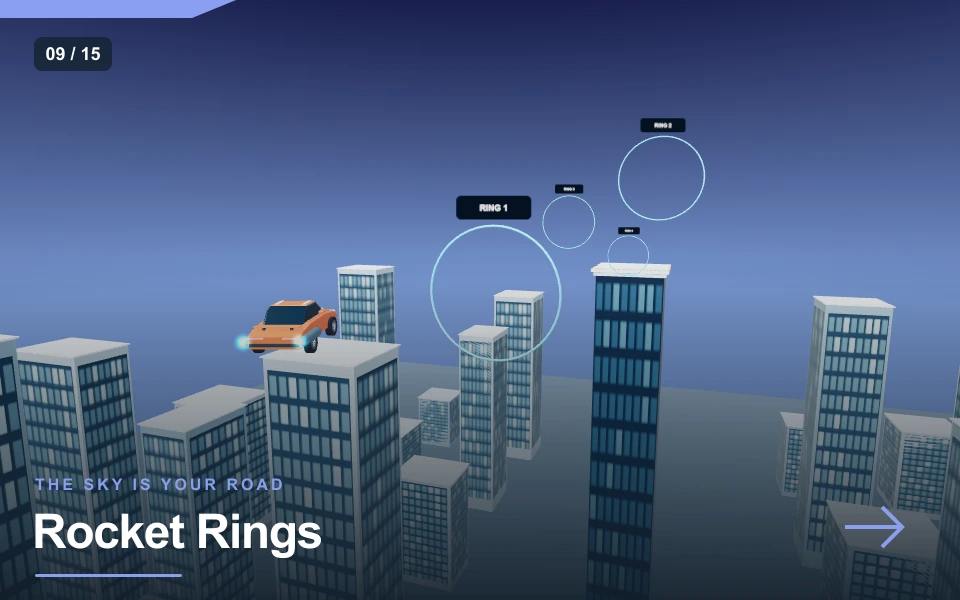
The car begins above a launch roof with forward movement already present. Four ring targets extend over the skyline. The first is near the central line, the second is higher and to the right, the third shifts left and the final one is lower again. They must be reached in order.
Progress changes when the car enters the active ring’s capture region. A later ring cannot substitute for an earlier miss. The completed target disappears, making the next one easier to identify. There is no landing requirement after the fourth ring; reaching the whole ordered route completes the mission in flight. The HUD shows RINGS, remaining FUEL and a NEXT RING direction hint. The mission also has a 90-second limit. Unlike road games, the car does not wait for you to hold an accelerator before travelling forward.
Pitch controls height, yaw controls the flight line
W pitches the car upward and S pitches it downward. A and D turn its yaw left and right. These inputs gradually change attitude, so holding one for a long time builds a larger correction than tapping it. Releasing leaves the chosen attitude rather than instantly pointing the nose back toward the next target.
Set an initial climb toward the first ring, then use S briefly if you need to reduce that climb. A useful correction includes both changing attitude and giving the flight movement time to respond. The velocity is smoothed toward a target flight direction, which keeps the car controllable but still prevents instant sideways movement. On touch screens, the pitch and yaw buttons provide the same actions. There is no normal brake or reverse command in this mode. Use the changing flight line, height and target hint to decide the next correction.
Use the next-ring hint as a coarse reference
The direction display reports whether the active target is left, right or roughly aligned, and whether it is above, below or near your current height. It is guidance about position, not an autopilot that controls the car. The hint can change before your existing lateral motion has stopped, so also inspect the visible trajectory.
Start a sideways change before reaching the target’s depth. If you arrive at the right height but several car-widths to one side, the ring still will not count. If you are correctly lined up sideways but descending through its lower edge, adjust pitch earlier on the next attempt. A ring has a generous capture region tuned for this short browser game, but it is not a complete corridor that credits any flight at the same distance. A missed active ring remains required even after you have travelled farther along the route.
Lift is useful, but it spends extra fuel
Space adds lift while held and increases fuel consumption. It can help correct an approach that is too low without needing to build as much nose-up attitude. Release when the vertical line becomes useful, because continued lift can carry above the ring and use fuel that would have supported later flight.
Ordinary flight also spends fuel over time. The FUEL display therefore decreases even when you are not holding lift. This reserve is not the regenerating road boost used in football or highway racing. It does not refill by releasing Space. The vehicle’s forward powered movement remains part of the mode, while pitch and yaw determine your line. If the reserve empties, the attempt ends. Fuel management matters most when a miss forces a longer repositioning rather than when the ordered route is followed cleanly on the first pass.
Plan the direction reversal between rings
The second and third targets sit on opposite sides of the route. Once the second counts, begin planning the turn toward the third instead of holding the same rightward attitude. A lateral velocity takes time to change, so an early heading change can be more useful than a large late input.
The final target asks you to lose height as well as return toward the centre. Start descending deliberately and reduce the pitch change as the approach aligns. Avoid holding downward input until the ring has already passed; that can create a continuing descent with the active target behind you. The car can yaw around if you need to revisit a missed ring, but a broad turn uses time and fuel. A restart gives the same clean opening and restores all targets, which is often more useful while practising a particular transition.
Rocket-inspired visuals and a forgiving flight model
NASA’s introductory rocket-thrust material explains the basic idea of producing movement by expelling propellant. The side boosters and glowing exhaust create that visual theme here. The flight model itself is deliberately simplified: input-controlled attitude guides smoothed movement, with lift assistance and reduced effective gravity.
There is no realistic aerodynamic simulation, orbital navigation, gear system or vehicle upgrade tree. The skyline is a setting rather than an explorable city. The car body still exists in the physical world, but the mission is about entering airborne targets, not driving on the launch roof. The R recovery shortcut spends time and returns the body to the launch position; it does not refill the remaining fuel or reset ring progress. A full restart restores the entire mission. Keep that distinction in mind when choosing a retry after a poor opening.
Practise height, then add lateral transitions
For the opening attempt, focus only on reaching the first ring at a controlled height. Use a short pitch change, watch how the car’s path responds and correct before you are directly beside the target. On a later attempt, practise moving right toward the higher second ring without continuing to climb after it counts.
Next, rehearse the reversal toward the third. Change heading early enough that the visible sideways motion has started responding before arrival. Compare where you missed: a height error needs a different correction from a lateral error. Keep lift use brief while learning what pitch alone can do. Rooftop Leap also uses height, but it depends on a grounded launch and fixed landing surfaces. Orbit Breaker stays available for a corridor-style space flight. Rocket Rings is the vehicle game for sustained airborne attitude control and a route defined by separate elevated targets.
Graphics, sound and fullscreen settings
Side boosters and glowing exhaust distinguish the flying car. Elevated rings contrast against the city, and completed targets disappear. The camera follows the airborne attitude, while the next-ring hint provides a coarse left-right and height reference. That hint is useful guidance rather than an automatic flight controller.
Sound begins after a player interaction. The shared audio system provides a synthesised engine layer, short action cues and background music. Music can be switched off separately, and volume or mute controls adjust the output. Use fullscreen for a larger view; where native fullscreen is unavailable, the expanded player keeps the scene usable. High HD increases rendering resolution and shadow detail on supported devices. Light reduces those costs on a slower phone without changing the objective. Pause before changing focus; the game also pauses when you leave the tab. Choose the setting that keeps your controls responsive rather than assuming the highest option improves the physics.
Pros & cons
What works well
- Flight uses pitch, yaw and lift rather than normal road controls.
- Ordered targets change both lateral position and height.
- A next-target hint makes positional errors easier to diagnose.
Practical limits
- Forward movement continues while you make corrections.
- Fuel is consumed continuously and does not regenerate.
- The assisted flight model is deliberately simpler than an aircraft simulator.
Choose your next challenge
The shared player makes it easy to switch games, but each mission asks for a different decision. Compare the objective rather than expecting one score to mean the same thing across every mode.
| Game | Objective | Session |
|---|---|---|
| Rocket Rings | Fly a rocket-powered car through four elevated rings before its fuel runs out. | 90 sec limit |
| Rooftop Leap | Charge a jump and land on three different skyscraper roofs. | 150 sec limit |
| Orbit Breaker | Survive the two-minute flight and earn points from gates, distance and cleared asteroids. | 120 sec on High |
Frequently asked questions
Why does the car move without W?+
Forward powered flight is automatic. W changes pitch upward instead of acting as a road accelerator. Use S to adjust downward, A and D for yaw, and Space for extra lift.
Does releasing a turn instantly straighten the flight?+
No. Inputs change the chosen attitude, and velocity responds smoothly. Counter the previous input when you need a new heading. Plan corrections ahead of a target rather than waiting until it is beside the car.
Why did a later ring not count?+
The targets must be reached in order. A missed active ring remains required even if you fly near a later one. Follow the progress counter, visible active target and NEXT RING direction hint.
Does lift regenerate like road boost?+
No. Lift spends additional fuel on top of normal flight consumption. Releasing it reduces the drain but does not refill the reserve. A full restart restores fuel and resets the ring route.
Final words
Rocket Rings rewards a measured attempt and a clear understanding of the current mission. Start with Low, practise one section at a time and use the reset control when you need a safe position. Watch what changed between attempts before adding more speed. The useful result is a technique you can repeat, with room to improve on the next run.