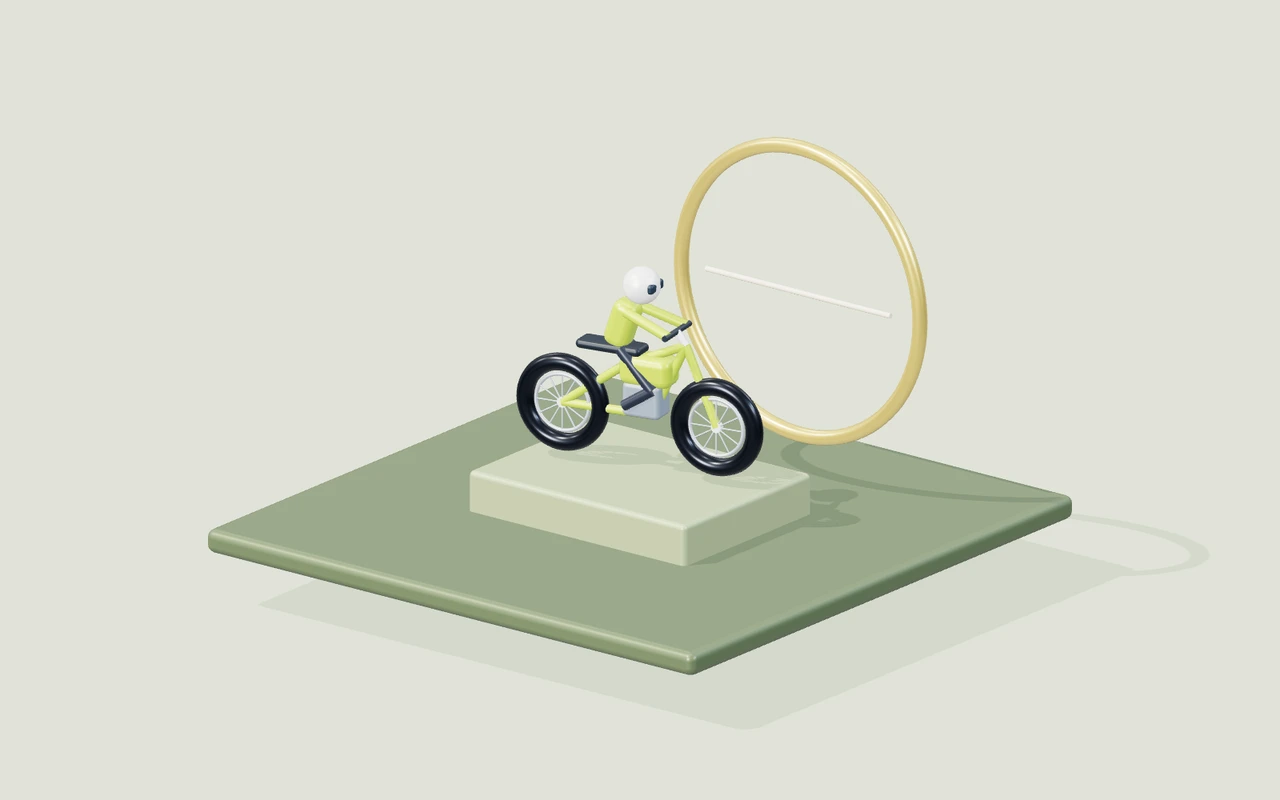
A bike course creates a different rhythm from a car route. Wheel-driven movement, a tilting chassis and a grounded hop make the rider’s balance part of each gap. Bike Trials uses shorter rooftop steps with changing heights, while Bike Motocross combines dirt ramps with an actual gap and a longer finish run. They share some controls, but they do not ask for the same sequence of decisions. This article explains how to separate throttle, lean, takeoff and landing, then gives small comparisons that make a missed hop useful instead of turning every attempt into another immediate crash.
Two courses, two rhythms: Read the terrain before applying the motor
Bike Trials asks for deliberate movement between discrete supported pads. The next step can change both height and available landing room. Bike Motocross instead gives a dirt course with ramps and a gap along the route to its finish. A throttle sequence that works on a long dirt approach may be too rushed for a short rooftop setup.
Look at the next surface before deciding how much movement to build. Is it a ramp, an open gap, a higher pad or a supported area where you should settle? That description gives the motor input a purpose. The bike’s controls remain familiar, but the useful next action changes with the course. Treat the terrain as information rather than background to be crossed with the same held throttle from start to finish.
Throttle is an approach decision: Keep room for the hop
The rear-wheel motor builds movement gradually. A short approach and a long approach therefore create different takeoff conditions even if you press the same throttle button. On Trials, it is particularly useful to preserve room for positioning and the grounded hop instead of arriving at the edge with the entire setup unresolved.
Practise a short supported acceleration, release and stop before combining the controls into a gap attempt. Notice how much space the sequence uses. Then choose a launch position that lets the bike reach a useful forward pace without crowding the edge. If a hop lands short, investigate the approach as well as the vertical action. If it overshoots a small pad, a calmer approach may help more than an additional lean correction halfway through the flight.
The hop begins with support: A late airborne press is a different event
The hop action needs grounded support and has a cooldown. It is not an unlimited midair launch that can always rescue a bike after it has left the pad. This gives takeoff timing a clear role in the challenge.
Choose a visible supported point for the hop and press the action there. Watch the bike leave the surface and identify whether the action happened before support was lost. A button pressed after the wheels have already entered the gap cannot be treated as the same launch. If several attempts feel unexpectedly weak, first check that the hop was available and grounded. Only then compare approach speed or airborne lean. This order prevents a missing takeoff event from being mistaken for a problem with every part of the flight.
Lean changes attitude: Use a measured correction
Lean influences the chassis angle, especially during flight. The purpose is to arrive with a usable orientation, not to hold a direction for as much of the jump as possible. A long correction can create a second balance problem before the original one is resolved.
Make a brief input and observe the attitude change before adding another. The balance readout helps connect the visible bike angle with the result. Low provides more assistance, which can make it easier to learn that relationship without immediate repeated overturns. Keep the setting consistent while comparing the length of a correction. A single stable arrival is useful; a stable arrival achieved through a recognisable brief input is something you can try to repeat on the next gap.
Landing completes the decision: Keep the next input calm
Reaching the far surface is not the only part of a successful hop. The bike must make useful supported contact and remain in a position from which the next section can begin. A rushed throttle input immediately after an awkward landing can carry the rider toward another edge before balance is understood.
Allow the bike to settle when the course offers that room. Check the next pad or ramp, then choose the next approach. On the changing heights of Trials, the launch that just worked is evidence rather than a universal instruction. The next surface may require a different approach. On Motocross, read whether the landing leads into a supported run or another terrain transition. The landing and next setup form a connected sequence.
Recovery preserves practice: Return to a supported checkpoint
A missed landing or an overturned bike uses a life and opens the Continue flow. Recovery restores the bike to a supported part of the course, clears unwanted movement and gives space to begin again. The three-life indicator makes the remaining opportunities visible rather than leaving a failed rider below the terrain with no usable control.
Before continuing, describe the main error. Was the hop late, the approach too slow, the angle overcorrected or the landing overshot? Choose one of those corrections for the next attempt. Reset vehicle can also return an awkward position to a clearer setup without using a page refresh as a riding control. After the last life, Play again starts a fresh run. Use the recovered condition to investigate a specific gap rather than repeating an entire rushed sequence unchanged.
Choose your pace: Difficulty and recovery
Start Bike Trials on Low while you learn its objective: Balance, climb and bunny-hop across rooftop steps to the final platform. Low is the default in this edition. For the new physical challenges it gives a larger time allowance and calmer handling; applicable courses also have wider landing surfaces or slower moving hazards. Medium sits between that assistance and the High challenge. The setting changes gameplay, while Graphics controls drawing quality. Keeping those decisions separate helps you answer the right question: is the task unfamiliar, or is the device struggling to draw it smoothly?
Each run begins with three lives. A detected failure uses one life and offers Continue from a safe checkpoint. The new vehicle challenges preserve completed objectives within the run; cargo recovery reloads the boxes, pursuit recovery restores shields, and bike recovery returns to a supported part of the course. After the last life, Play again starts a fresh run without reloading the page. Reset vehicle is also available for an awkward position. A voluntary reset does not need to become a repeated page refresh.
Changing difficulty starts a fresh run, because the layout and timing need to agree with the chosen setting. Your saved preference belongs to this browser and this game. Treat a comparison between Low and High as two different practice conditions, rather than evidence that the same score means the same performance. For a fair experiment, keep the difficulty, control method and starting checkpoint consistent. Increase the challenge after you can explain the action that reliably worked, instead of using a harder setting to compensate for a technique you have not yet understood.
Supported approach: Learn the motor
An initial pad gives enough room to observe how the rear-wheel motor builds movement before the course introduces a gap. Make a short throttle input, release it and brake gently. Keep the experiment on support instead of immediately combining it with a hop.
Notice the distance used and whether the bike settles upright. The motor’s gradual response becomes easier to plan after a controlled comparison. Use the calmer approach as a starting reference for the first gap. Add takeoff timing after the movement itself is understandable.
Grounded hop: Choose a visible point
The first gap asks for a hop while the bike still has support. A late press can happen after the wheels leave the pad. Use a recognisable point before the edge, press Hop while grounded and keep the initial approach similar across two attempts.
Watch whether the upward event happens on support and whether the cooldown has allowed another hop. A missing launch needs a timing correction first. Move the input earlier if support is lost before it acts. Do not add more airborne lean to compensate for a hop that never occurred.
Airborne lean: Avoid a long rescue input
A bike leaving a pad can begin to tilt, and holding one lean direction throughout the flight may create too much rotation. Apply a brief correction, release it and watch the balance readout. Compare the result with a longer input only from a similar launch.
Look at the arrival angle as well as whether the bike reached the surface. Distance and attitude can be separate parts of the result. Keep the smaller correction when it produces a usable landing. Add another input only when the visible attitude still requires it.
Higher step: Re-read the target
A Trials pad can sit higher than the one before it. Repeating a launch for a level gap may not create the same supported arrival. Inspect the new height, choose a deliberate approach and trigger a grounded hop. Keep a useful landing margin rather than aiming at the edge.
Watch whether the bike reaches the surface from above or contacts its side. The observation explains whether the approach and takeoff need adjustment. Change one part of the sequence for the next life. Treat the new pad as a new question while retaining the balance correction that worked.
Recovered ride: Begin with a clear next action
A missed gap or overturned chassis has used a life. Continue can return the rider to a safe supported checkpoint. Read the failure reason, choose one correction and resume from the restored pad. Let the bike settle before beginning the next approach.
Check the life indicator and the next terrain transition. Recovery should not require browser refresh or leave residual movement causing an immediate repeat fall. Use the safe setup to test the correction deliberately. After the last life, take the lesson into a fresh ride instead of replaying the same rushed inputs.
Decisions at a glance
| Situation | First decision | What to observe |
|---|---|---|
| Supported approach · Learn the motor | Make a short throttle input, release it and brake gently. Keep the experiment on support instead of immediately combining it with a hop. | Notice the distance used and whether the bike settles upright. The motor’s gradual response becomes easier to plan after a controlled comparison. |
| Grounded hop · Choose a visible point | Use a recognisable point before the edge, press Hop while grounded and keep the initial approach similar across two attempts. | Watch whether the upward event happens on support and whether the cooldown has allowed another hop. A missing launch needs a timing correction first. |
| Airborne lean · Avoid a long rescue input | Apply a brief correction, release it and watch the balance readout. Compare the result with a longer input only from a similar launch. | Look at the arrival angle as well as whether the bike reached the surface. Distance and attitude can be separate parts of the result. |
| Higher step · Re-read the target | Inspect the new height, choose a deliberate approach and trigger a grounded hop. Keep a useful landing margin rather than aiming at the edge. | Watch whether the bike reaches the surface from above or contacts its side. The observation explains whether the approach and takeoff need adjustment. |
| Recovered ride · Begin with a clear next action | Read the failure reason, choose one correction and resume from the restored pad. Let the bike settle before beginning the next approach. | Check the life indicator and the next terrain transition. Recovery should not require browser refresh or leave residual movement causing an immediate repeat fall. |
YOUR NEXT SESSION
Put it into practice
Start on Low and practise one supported acceleration-and-stop sequence. Then choose the first gap and make a hop from a visible supported point. Compare one brief lean correction with a slightly different correction while preserving the takeoff. After a usable landing, inspect the next surface before applying throttle again. Try Motocross afterward and note how a dirt approach changes the rhythm compared with a short Trials pad. Keep one sentence about the takeoff or landing decision that improved the attempt.
Play Bike TrialsFrequently asked questions
Which game should I use for this practice?+
Use Bike Trials first: Balance, climb and bunny-hop across rooftop steps to the final platform. The article's examples are organised around its actual objective, rather than a generic racing score. Start with one exercise and a consistent difficulty, then try a related game when you can explain what changes between the two tasks.
Can I practise on a phone?+
The player provides touch controls beneath the scene, including the action buttons needed by Bike Trials. Use two comfortable fingers when actions must overlap. A keyboard offers a different physical arrangement, so allow a few attempts to learn the mobile timing instead of expecting identical finger movements. Keep the browser controls out of the way with fullscreen when that is more comfortable.
What should I do after a failure?+
Use Continue while lives remain. Read the visible reason first, because a missed landing, lost cargo or depleted shields asks for a different correction. After three lives, start a fresh run with Play again. Reset vehicle can recover an awkward position without refreshing the entire page. The browser retains preferences and available local records when storage is allowed.
Does the exercise promise a particular result?+
No. These are repeatable practice comparisons, not a guaranteed score or a real-world driving qualification. Timing, starting position and control method affect the result. Look for a reliable change in your decisions before treating a single good attempt as mastery. The game guide remains the place to check the complete mission rules and controls.
Final words
A bike gap becomes clearer when its stages are separated: read the terrain, build a useful approach, hop while supported, correct attitude briefly and settle the landing. Trials and Motocross use those stages in different rhythms. Low assistance, the balance readout and three-life recovery give you room to turn a missed hop into a specific next decision.
Choose one idea from this article, try it in your next run, and notice what changes. A calmer, repeatable attempt gives you something useful to build on.