The second launch in Stunt Bowling should answer a different question from the first. Your opening meets a complete ten-pin triangle; later launches meet the arrangement that those collisions left behind. Fallen pins stay down within the attempt, so copying an opening aim without looking again can waste a useful shot. This guide explains how to read that changing target, prepare a deliberate charge and use the result to select the next line. It concerns this game’s physical car-and-pin challenge, with three launches rather than a regulation bowling scorecard. Success depends on clearing the actual remaining arrangement, not repeating the most dramatic-looking impact.
Read the upright group: The original triangle is only the opening
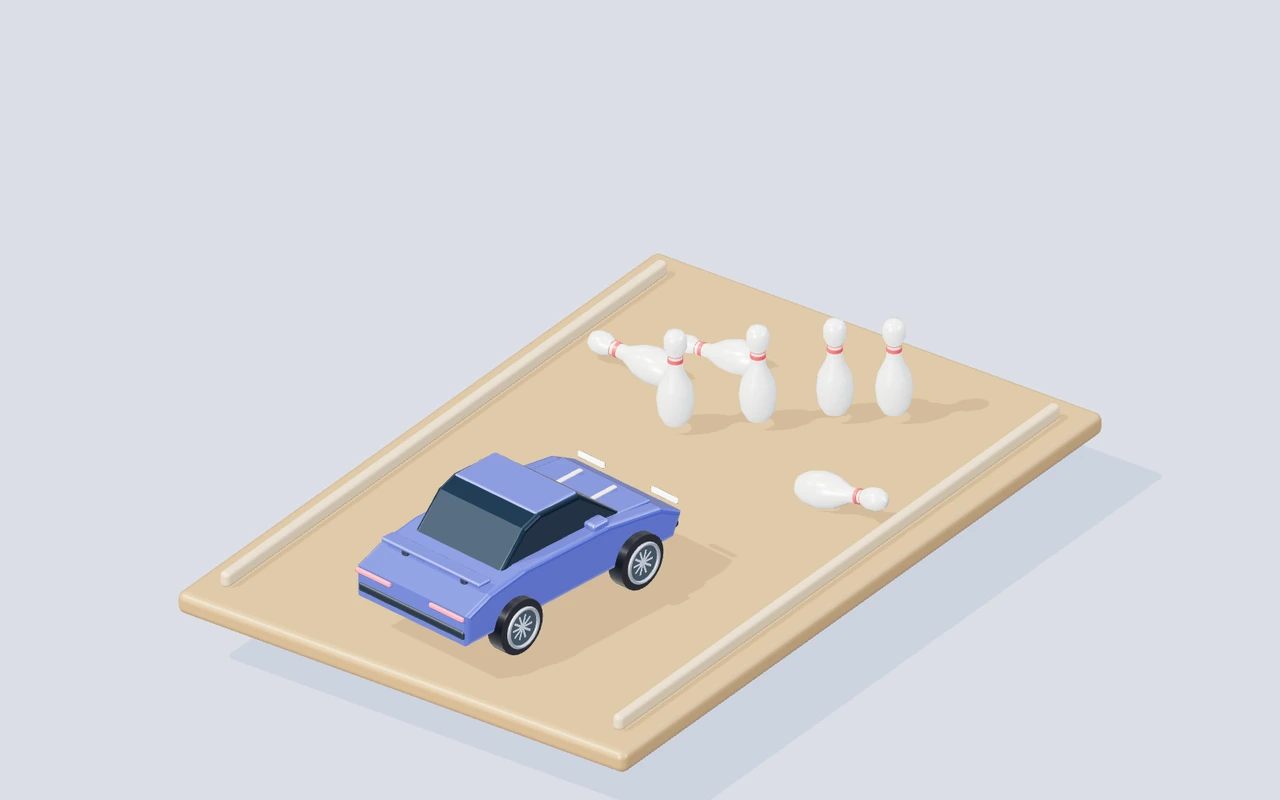
Before charging, separate upright pins from bodies already lying across the lane. The fallen shapes can draw attention because they move and overlap, but the mission still needs the standing pins to lose support. Look at the remaining group and decide which first contact offers a useful route into it.
During the opening, a central approach can introduce you to the whole arrangement. On a later shot, an isolated side pin or a rear cluster may deserve a different heading. Do not assume that the first aim remains useful simply because it previously produced several falls. The arrangement has changed. A small aiming adjustment should have a purpose you can explain before release: reach that cluster, approach that standing pin or send contact toward those neighbours. Watching the actual target gives the next shot its own identity and makes a miss more informative than a blind repeat.
Choose the contact line first: Charge cannot repair an unclear aim
A and D change the car’s setup heading through the allowed aiming range. They do not provide ordinary road steering throughout the shot. Use short presses before launch and inspect where the heading points relative to the pins that remain upright.
Keep charge familiar while investigating aim. A stronger launch along the wrong line can pass a target more emphatically without making the direction useful. If a side cluster survived, test a heading directed toward that cluster rather than automatically filling the power meter. Once contact becomes readable, you can investigate whether a different charge helps the same approach. Separating these decisions also makes the third shot easier to plan. You will know whether the second launch missed its intended group or met it without creating enough useful follow-on contact. Those are different observations and need different next experiments.
Release deliberately: A launch starts on the release
Hold Space to build the visible POWER meter, then release to launch the car. A brief tap and a longer hold create different launches, while the charge has a cap. Continuing to hold after that cap does not create unlimited strength. On touch, use the corresponding labelled charge action and make the release just as deliberate.
Watch the meter while holding, but return attention to the target before releasing. An understandable shot has a chosen line and a charge you can recognise again. If you change both at the last moment, the outcome becomes harder to connect with your preparation. After launch, watch the physical motion rather than continuing to press racing inputs that are not active controls in this mode. The interesting question is what the launched bodies do on contact. Your next preparation begins after that consequence is visible, not while trying to steer the airborne shot like a normal road game.
Allow the chain to settle: Touching is different from toppling
A pin can receive contact while remaining upright, or fall after another body reaches it a moment later. The first impact therefore does not describe the whole shot. Watch the arrangement settle and compare the visible standing pins with the mission’s progress feedback.
Do not count every touched pin as a cleared target. The game reads physical orientation and height, so a brush that leaves a pin supported can still require another launch. Equally, an apparently quiet first contact may start a useful chain across neighbouring pins. Give that sequence time to become readable before planning around an imagined immediate result. The next car launch returns to the setup end while the arrangement remains, letting you respond to the actual consequences. A fresh run restores the full opening triangle. Use it when you want another complete three-shot experiment, rather than confusing it with the normal return between shots.
A central opening leaves a side cluster
Your first launch takes several pins down through the middle. When movement settles, a small group remains standing to one side of the lane, away from the line that made the opening successful. Aim the second launch toward that surviving group with short A or D presses. Keep a recognisable charge while learning the new direction, and inspect the intended first contact before committing to the release.
Watch whether the car reaches the chosen upright group and whether contact travels into its neighbours. A lower total from this shot can still be useful if it clears targets the opening line did not reach. Use the third launch for whatever truly remains. Preserve the useful change of aim instead of treating every shot as a fresh attempt at the original centre of a triangle that no longer exists.
A strong launch passes the remaining pin
The POWER meter fills and the car travels quickly, but the lone upright target stays beside the path. The dramatic movement suggests strength was available, while the surviving pin shows that the line was unhelpful. Make aim the next question. Select a heading that should create contact with the standing pin and keep the charge familiar enough to compare direction. Avoid simultaneously adding another large angle change and a new power guess.
Read the closest part of the car’s path against the target. A useful comparison shows whether the changed line reaches it; speed alone cannot explain a miss that goes to the wrong side. If contact occurs without toppling, investigate charge or contact placement afterward. Keep the steps separate so the next experiment addresses an observed physical result rather than replacing every part of the shot at once.
A touched pin remains supported
A pin moves slightly when the car or another body brushes it. You expect the progress count to rise immediately, yet the shape settles upright and remains part of the final group. Wait for the collision sequence to finish, then treat that pin as a target again. Choose a later line that can create a more useful contact instead of assuming the earlier touch already satisfied the objective.
Compare visible orientation with the progress feedback. The game counts sufficient tilt or fall, so an animation of movement by itself is not evidence that the pin has been cleared from the mission. Prepare the next shot around the settled arrangement. If the pin does eventually fall through a later chain, update the target again rather than launching at a position that was relevant only during the first moment of impact.
The last launch is spent on fallen bodies
After two shots, the lane contains a busy pile and a few upright pins behind or beside it. Your attention stays on the pile, and the final heading follows the same visible movement that dominated the previous shot. Pause preparation long enough to identify the standing targets. Choose one useful first-contact area, inspect the line from the launch end and use the final charge deliberately rather than rushing to repeat the prior impact.
Watch whether the shot addresses surviving pins rather than merely moving fallen ones. Physical clutter still affects contact, but the useful mission evidence is the remaining count and the final supported arrangement. On a fresh run, remember the reading routine rather than only the last angle. The three-shot sequence becomes more effective when each preparation responds to the previous result, even if a new opening creates a different final cluster.
Keep the experiment useful: Controls, recovery and setup
Before trying the exercise, confirm the current mission in Stunt Bowling: Aim and launch your car to topple ten physical pins in three shots. The player’s controls table is the reference for the actual actions available. A / D means aim the launch. Hold then release Space means charge power, then launch the car. Start and focus the canvas before using the keyboard. On a phone, use the labelled touch actions under the scene. Change one input at a time while learning the response; unfamiliar finger placement can otherwise look like an unexplained change in the game’s handling.
Difficulty and Graphics answer different questions. Low creates a calmer learning condition by changing the relevant mission settings; Medium removes some assistance; High uses the base challenge. Changing difficulty begins a fresh run, so choose it before comparing attempts. Graphics changes the rendered scene: Low reduces resolution and disables sunlight shadows, Medium adds shadows, and High increases sharpness, shadow detail and material reflections. A clearer picture can help you read the scene, but it does not replace the movement decision described in this article. Keep difficulty fixed while testing a technique.
Three lives give a run room to continue after detected failure. Read the reason on the Continue panel and choose one correction before recovering. Continue restores a safe position while completed mission objectives remain where the mode supports them. Reset vehicle can recover an awkward position without refreshing the page or spending a life. Recovery does not mean a completely fresh mission: choose Start a new run when you want the original opening. A paused panel stops the active simulation, and a voluntary reset adds no time penalty.
Use the pause control if you need to read, change hand position or look away. Sound and background music have separate controls and begin after an interaction; they are optional feedback rather than prerequisites for understanding the visible target. Fullscreen gives the scene more room, with an expanded-player fallback where the native API is unavailable. If your experiment is about steering or timing, keep the browser, input arrangement and graphics profile consistent. A score from one isolated attempt tells you less than a decision that leaves the vehicle well positioned in several attempts.
Decisions at a glance
| Situation | Useful action | Evidence to watch |
|---|---|---|
| A central opening leaves a side cluster | Aim the second launch toward that surviving group with short A or D presses. Keep a recognisable charge while learning the new direction, and inspect the intended first contact before committing to the release. | Watch whether the car reaches the chosen upright group and whether contact travels into its neighbours. A lower total from this shot can still be useful if it clears targets the opening line did not reach. |
| A strong launch passes the remaining pin | Make aim the next question. Select a heading that should create contact with the standing pin and keep the charge familiar enough to compare direction. Avoid simultaneously adding another large angle change and a new power guess. | Read the closest part of the car’s path against the target. A useful comparison shows whether the changed line reaches it; speed alone cannot explain a miss that goes to the wrong side. |
| A touched pin remains supported | Wait for the collision sequence to finish, then treat that pin as a target again. Choose a later line that can create a more useful contact instead of assuming the earlier touch already satisfied the objective. | Compare visible orientation with the progress feedback. The game counts sufficient tilt or fall, so an animation of movement by itself is not evidence that the pin has been cleared from the mission. |
| The last launch is spent on fallen bodies | Pause preparation long enough to identify the standing targets. Choose one useful first-contact area, inspect the line from the launch end and use the final charge deliberately rather than rushing to repeat the prior impact. | Watch whether the shot addresses surviving pins rather than merely moving fallen ones. Physical clutter still affects contact, but the useful mission evidence is the remaining count and the final supported arrangement. |
YOUR NEXT SESSION
Put it into practice
Make one full attempt with a familiar opening charge. After the first shot, name the upright group the second shot should meet. Change aim for that group while keeping charge understandable. Wait for movement to settle again, then choose the third line from the actual survivors. Record the observation in plain language: central pins fell, side group stayed; line reached group, contact was weak; or pin moved but remained upright. In another fresh attempt, compare one opening aim change rather than assuming that an exact three-shot sequence works for every physical result.
Play Stunt BowlingFrequently asked questions
Do I use ordinary racing throttle after launch?+
No. This mode uses A and D for setup aim and a held-then-released Space action for launch power. After release, the car and pins move physically. Read the current controls rather than importing the throttle-and-steering routine from a road challenge.
Why should the second shot use a different aim?+
The standing arrangement may have changed. Earlier fallen pins stay down within the attempt, so a side group or isolated rear target can require a different first contact. Keep the previous line only if it still serves a useful standing target.
Does this use official strike and spare scoring?+
No. The goal is to topple ten physical pins within three car launches and the mission timer. There is no regulation ten-frame scorecard. Judge the attempt through the cleared targets and remaining arrangement, rather than calculating conventional bowling bonuses.
Final words
Three launches are three changing decisions. Read standing pins, choose a purposeful line, release a familiar charge and wait for physical contact to settle. Let the remaining arrangement explain the next shot instead of copying an opening that has already done its job.
Choose one idea from this article, try it in your next run, and notice what changes. A calmer, repeatable attempt gives you something useful to build on.