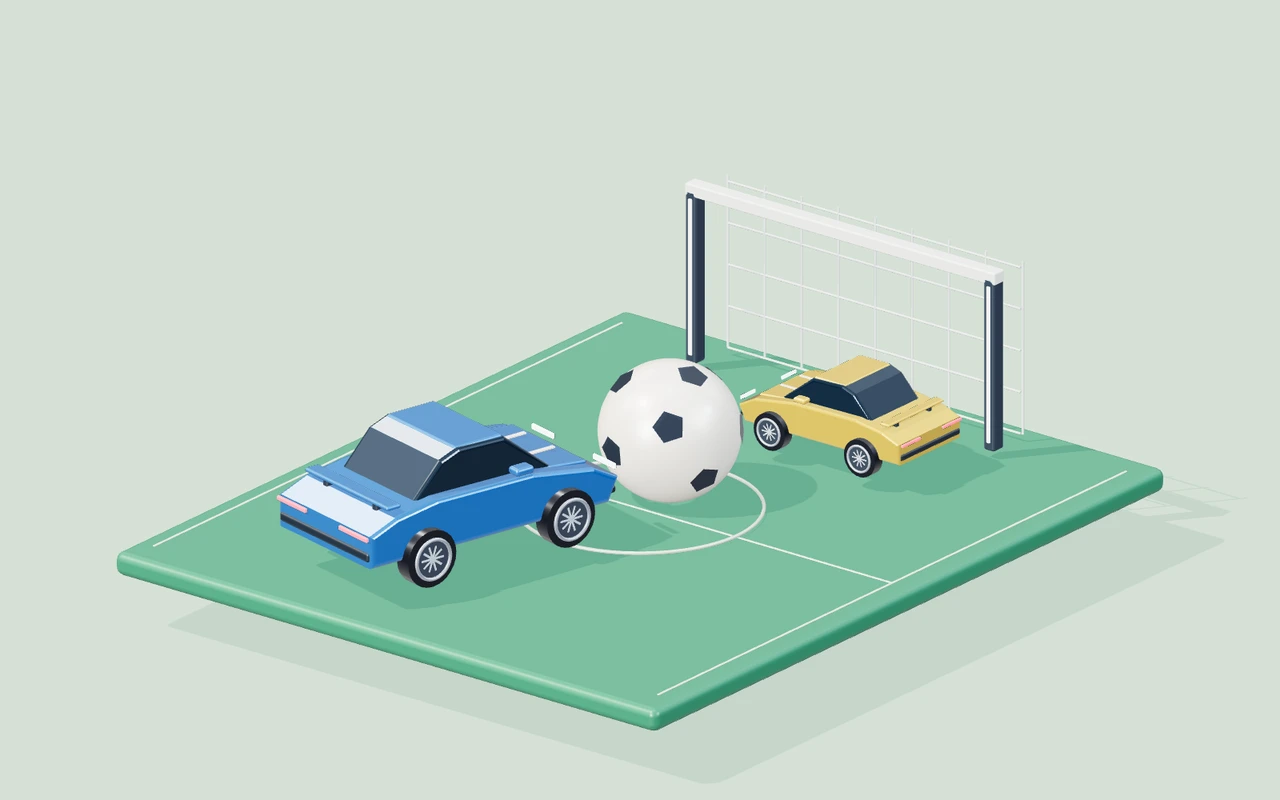
A car football game asks you to control two things in succession: your vehicle and the ball it contacts. Driving toward the goal does not automatically mean the ball will follow the line you intended. The position and direction of contact matter, and the moving goalkeeper responds to the ball’s position. Turbo Football makes those relationships the central task. You must score three goals by driving a physical ball through the goal opening, rather than simply reaching the far end of the pitch. This article explains how to build an approach, read the keeper and make a contact that leaves another useful decision instead of an uncontrolled chase.
The ball has its own path: Plan the contact before accelerating
The vehicle can be aimed at the goal while the actual contact sends the ball sideways. A useful approach begins with where the car meets the ball and the direction the car is travelling at that moment. Hitting the nearest visible part as fast as possible is a strategy, but it may create a path that is difficult to follow.
Watch the ball after a modest contact before making a harder one. Notice whether it travels along the intended line, deflects toward a wall or creates an opportunity for a second push. This separates ball control from car control. You can be steering the vehicle accurately while still choosing an unhelpful contact angle. A calmer first touch can make the next touch easier to organise, even when it does not immediately score.
The opening has boundaries: Aim at useful goal space
Turbo Football recognises a ball that crosses the goal line inside the goal’s usable opening and height. Sending it beyond the line somewhere else is not enough. The posts and goalkeeper provide visual references, but the entire far boundary should not be treated as a target.
Choose a part of the opening that your current approach can reach. A ball close to one side may need an angle across the pitch; a centred ball may offer more than one option. Avoid applying a huge last-second direction change simply because the goal is visible ahead. The useful question is whether the ball’s likely path reaches the opening. If it does not, make a controlled repositioning or another contact before attempting a stronger push.
Read the keeper: A direct central push is only one option
The keeper moves laterally in response to the ball’s position. This makes a straightforward central push vulnerable to a predictable block. It also means the keeper’s current location is not a permanent hole or barrier; it can change as the ball changes position.
Observe that movement from a manageable distance. Try an approach that places the ball to one side, then look for a contact angle toward useful goal space. You do not need to invent a complicated trick sequence. The point is to recognise that car, ball, keeper and opening form one changing situation. If the keeper repeatedly stops the same direct line, examine the line before assuming the answer is simply more boost.
Use boost with a purpose: Keep the setup under control
Boost increases the car’s movement, but extra speed can make the precise contact more difficult. A rushed approach may hit the ball before the line is ready or send it beyond a useful second-touch position. Speed is most useful after you know what contact you want.
Build the setup at a calm pace. Choose the direction, align the vehicle and then use extra movement if it serves that contact. Compare one moderate push with one boosted push from similar positions. Watch the ball’s path and the keeper’s response rather than judging the contact by how dramatic it appears. A strong push that misses the opening may be less useful than a controlled one that creates a clear next chance.
The next goal is a new setup: Re-read the pitch after progress
Scoring does not leave the pitch in exactly the same arrangement. The ball is placed for another attempt and the car is reset, while the three-goal objective continues. Treat that restart as a new situation rather than holding the previous steering and expecting an identical result.
Check the ball’s current side, the car’s line and the keeper before choosing the next approach. The first successful contact is still useful evidence, but its angle may need to be adapted. This is one reason a three-goal mission can remain interesting after a single goal feels easy. You are applying the same principles to a changing setup, not replaying a button combination that should work regardless of position.
Recover an unhelpful ball: Keep the practice question clear
A ball that has rolled beyond the useful playing area is restored by the game. The ball reset control is also described in the game guide. Vehicle recovery and a ball reset solve different problems: one restores a usable car position, while the other gives the ball a clearer setup.
Use those controls when a practice comparison has become a long chase that no longer answers the original question. If you are learning contact angles, return to a readable setup and make a modest push. If you are learning a stronger approach, establish the angle first. Three lives and the in-player Continue flow prevent a detected vehicle failure from becoming a stuck page. Your next useful decision should still be about football rather than recovering browser navigation.
Choose your pace: Difficulty and recovery
Start Turbo Football on Low while you learn its objective: Drive the ball past a moving goalkeeper and score three goals. Low is the default in this edition. For the new physical challenges it gives a larger time allowance and calmer handling; applicable courses also have wider landing surfaces or slower moving hazards. Medium sits between that assistance and the High challenge. The setting changes gameplay, while Graphics controls drawing quality. Keeping those decisions separate helps you answer the right question: is the task unfamiliar, or is the device struggling to draw it smoothly?
Each run begins with three lives. A detected failure uses one life and offers Continue from a safe checkpoint. The new vehicle challenges preserve completed objectives within the run; cargo recovery reloads the boxes, pursuit recovery restores shields, and bike recovery returns to a supported part of the course. After the last life, Play again starts a fresh run without reloading the page. Reset vehicle is also available for an awkward position. A voluntary reset does not need to become a repeated page refresh.
Changing difficulty starts a fresh run, because the layout and timing need to agree with the chosen setting. Your saved preference belongs to this browser and this game. Treat a comparison between Low and High as two different practice conditions, rather than evidence that the same score means the same performance. For a fair experiment, keep the difficulty, control method and starting checkpoint consistent. Increase the challenge after you can explain the action that reliably worked, instead of using a harder setting to compensate for a technique you have not yet understood.
First touch: Follow the ball
The ball begins ahead of the car, with the keeper and goal visible beyond it. This offers a simple contact to observe. Approach at a moderate pace and make one push without trying to combine several sharp turns and boost into the same moment.
Watch the ball’s path relative to the car’s heading. Notice whether you remain in a position from which another contact can be planned. If the touch creates an uncontrolled sideways chase, improve alignment first. Speed can be compared after the direction becomes repeatable.
Central keeper: Change the line
Repeated straight pushes can bring the ball into the keeper’s central response, even when the car reaches it cleanly. Use a readable setup to approach the ball from an angle. Look at the usable opening and the keeper before choosing the intended path.
Observe whether the changed contact sends the ball toward open goal space or merely moves the problem to another part of the pitch. Keep the angle that creates a useful opportunity. Do not assume a more sideways contact is better unless the ball’s path supports that conclusion.
Strong contact: Test boost separately
A good moderate push offers a reference for deciding whether added speed actually improves the scoring opportunity. Repeat from a similar setup with a brief, purposeful boost. Keep the contact line similar enough that the difference remains understandable.
Compare the ball’s direction, your follow-up position and the keeper’s interaction. A larger impact is not automatically a cleaner scoring attempt. Use boost where it helps a prepared contact. Reduce it when the extra movement makes alignment or the next touch less predictable.
After a goal: Read the new ball position
The next attempt can begin with the ball placed differently from the contact that produced the previous goal. Release unnecessary controls, inspect the new arrangement and choose a fresh approach line before applying stronger movement again.
Look for whether the ball is now to a different side and whether the previous contact angle still points toward useful opening space. Adapt the line while retaining the principle that worked. Repeating the same input without reading the setup can waste a successful lesson.
Reset and practise: Avoid a meaningless chase
The car and ball can become separated after a poor touch, making the original angle comparison difficult to continue. Use the appropriate reset from the guide or recover the vehicle, then rebuild a calm setup for the contact you want to investigate.
Check that the next attempt begins in a position you can describe. A consistent setup makes the observed ball path more useful evidence. Choose one correction to the contact and repeat it deliberately. Save full-session restarts for a fresh attempt rather than every awkward touch.
Decisions at a glance
| Situation | First decision | What to observe |
|---|---|---|
| First touch · Follow the ball | Approach at a moderate pace and make one push without trying to combine several sharp turns and boost into the same moment. | Watch the ball’s path relative to the car’s heading. Notice whether you remain in a position from which another contact can be planned. |
| Central keeper · Change the line | Use a readable setup to approach the ball from an angle. Look at the usable opening and the keeper before choosing the intended path. | Observe whether the changed contact sends the ball toward open goal space or merely moves the problem to another part of the pitch. |
| Strong contact · Test boost separately | Repeat from a similar setup with a brief, purposeful boost. Keep the contact line similar enough that the difference remains understandable. | Compare the ball’s direction, your follow-up position and the keeper’s interaction. A larger impact is not automatically a cleaner scoring attempt. |
| After a goal · Read the new ball position | Release unnecessary controls, inspect the new arrangement and choose a fresh approach line before applying stronger movement again. | Look for whether the ball is now to a different side and whether the previous contact angle still points toward useful opening space. |
| Reset and practise · Avoid a meaningless chase | Use the appropriate reset from the guide or recover the vehicle, then rebuild a calm setup for the contact you want to investigate. | Check that the next attempt begins in a position you can describe. A consistent setup makes the observed ball path more useful evidence. |
YOUR NEXT SESSION
Put it into practice
Begin with three moderate contacts and describe the ball’s path after each. Choose the contact that leaves the clearest next opportunity. Next, compare a central approach with an angled approach while watching the keeper. Try boost only after one line is understandable. During a three-goal attempt, stop briefly after each goal to read the new setup. Your aim is to explain why a contact helped, rather than to produce an impressive but unrepeatable collision.
Play Turbo FootballFrequently asked questions
Which game should I use for this practice?+
Use Turbo Football first: Drive the ball past a moving goalkeeper and score three goals. The article's examples are organised around its actual objective, rather than a generic racing score. Start with one exercise and a consistent difficulty, then try a related game when you can explain what changes between the two tasks.
Can I practise on a phone?+
The player provides touch controls beneath the scene, including the action buttons needed by Turbo Football. Use two comfortable fingers when actions must overlap. A keyboard offers a different physical arrangement, so allow a few attempts to learn the mobile timing instead of expecting identical finger movements. Keep the browser controls out of the way with fullscreen when that is more comfortable.
What should I do after a failure?+
Use Continue while lives remain. Read the visible reason first, because a missed landing, lost cargo or depleted shields asks for a different correction. After three lives, start a fresh run with Play again. Reset vehicle can recover an awkward position without refreshing the entire page. The browser retains preferences and available local records when storage is allowed.
Does the exercise promise a particular result?+
No. These are repeatable practice comparisons, not a guaranteed score or a real-world driving qualification. Timing, starting position and control method affect the result. Look for a reliable change in your decisions before treating a single good attempt as mastery. The game guide remains the place to check the complete mission rules and controls.
Final words
Car football is a chain of positions and contacts. Read the opening, prepare the car’s line, watch the ball’s independent path and account for the moving keeper. A useful touch leaves another decision available. Boost, resets and recovery work best when they support that planned contact instead of replacing it.
Choose one idea from this article, try it in your next run, and notice what changes. A calmer, repeatable attempt gives you something useful to build on.