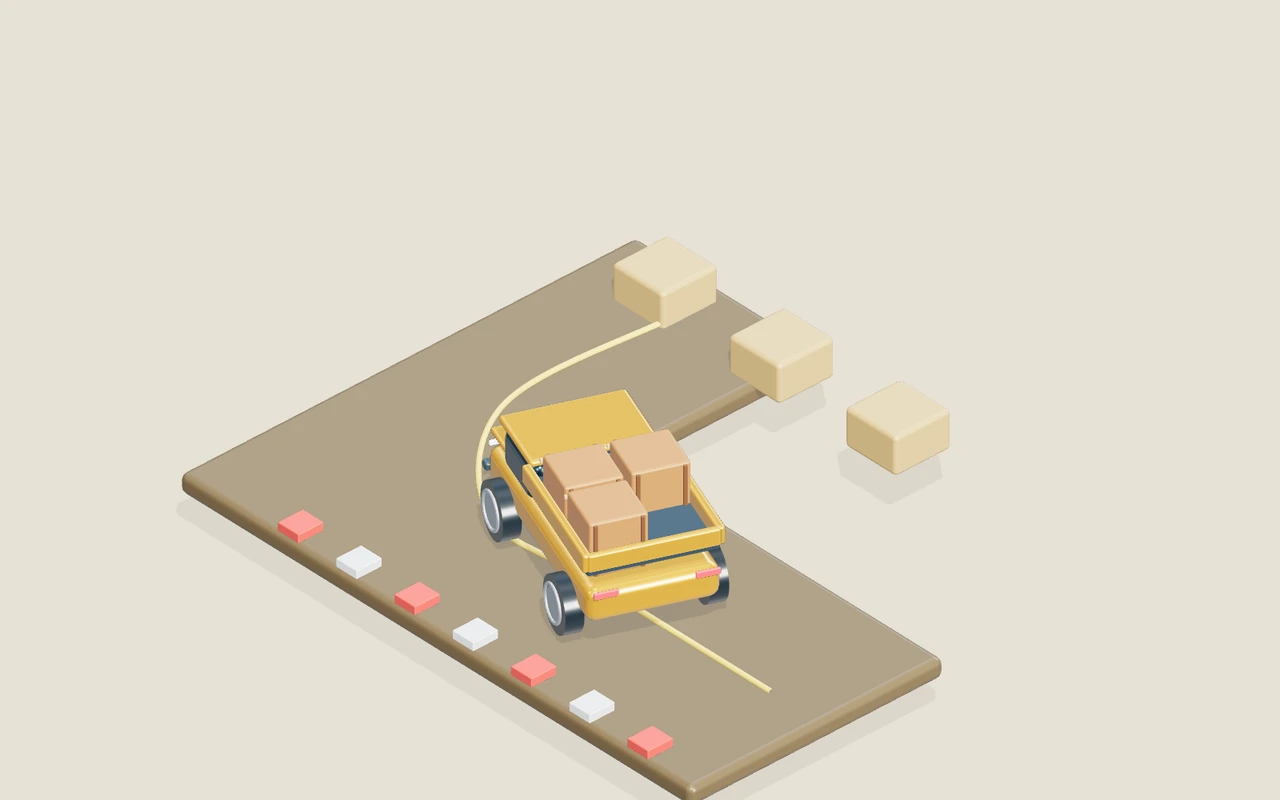
Cargo Balance makes the car’s movement only part of the mission. Three loose crates travel in the pickup bed, and they must remain together through a winding harbour route. A fast turn can send the load toward a side; a harsh transition can disturb boxes that looked settled a moment earlier. The challenge is to make the movement calm enough that the cargo still arrives with you. This article breaks the route into acceleration, braking, cornering and a final stopped delivery, then gives small comparisons that show which input is causing a repeated loss.
The load is a separate object: Watch it during transitions
The crates are physical objects above the chassis rather than a number painted on the vehicle. They respond to movement and contact, so a change that seems modest from the following camera can still disturb the load. The useful observation is when the boxes begin to shift, not only when one finally leaves the truck.
Start with a short supported movement in a clear part of the route. Accelerate, release the control and watch how the cargo settles. Then add a gentle turn. Separating these actions lets you see whether the disturbance began with speed, direction or a transition between them. The mission becomes clearer when you think about the load’s state as well as the car’s position. A truck that reaches the destination without the crates has not completed the delivery.
Corner entry comes first: Reduce movement before changing direction
A winding route can encourage repeated left-right inputs when each new target appears. If those inputs begin while the vehicle is already moving quickly, the cargo has less room to remain settled. A calmer approach starts the corner before the visible turning action: reduce speed while there is still straight space.
Brake early enough to make the next direction change deliberate. Release the brake as the vehicle reaches a manageable pace, turn with a measured input, then accelerate when the new line is clear. This does not mean every corner must be taken identically. It means a repeated loss should be investigated at the transition that caused it. If boxes shift at turn entry, try changing the entry before adding another correction halfway through the bend.
Steering is a sequence: Avoid alternating emergencies
Several small corrections can be useful, but a rapid series of opposing inputs can disturb a load while making the car’s path harder to read. One large turn followed immediately by a large correction in the other direction often changes the motion twice before the cargo has settled.
Choose the next route line while the car is still in a comfortable position. Begin the turn at the lower pace and release the direction once alignment is useful. Watch whether the car continues drifting toward the edge or remains on a manageable path. If a correction is needed, make it in response to that visible movement. The objective is a clear entry, direction change and exit, rather than an argument between the two steering buttons throughout the entire corner.
Progress follows the route: Keep the next stop in mind
The winding route has ordered progress points before the final delivery area. Reaching a later part of the harbour does not replace an earlier checkpoint. This makes route awareness part of the task: keep the active point in mind instead of taking an apparent shortcut toward the finish.
After passing a point, look for the next approach and begin reducing movement before it becomes a sharp steering problem. The route’s changing sides are an opportunity to establish a calm rhythm. A completed point also gives recovery a useful place to restore the vehicle. That helps a failed attempt teach you about a particular corner rather than requiring the whole route to be repeated before each comparison. Use the checkpoint as a reference for one deliberate correction.
Delivery includes stillness: Arriving is not the final action
The finish is a stable delivery hold with the load intact. Rolling through the pad too quickly is not the same as stopping there with all three crates. The last approach therefore needs its own braking plan, even if the earlier corners have gone well.
As the destination becomes visible, reduce speed before entering its usable area. Place the pickup comfortably on the pad, release unnecessary direction inputs and allow it to settle. Watch the cargo indicator and the stopped condition. If the truck keeps moving, another burst of throttle will not help complete a stable delivery. If a crate has left the load, recovery is the relevant next action. The final success connects route progress, cargo retention and a calm stop rather than distance alone.
Recover the whole delivery state: Learn from the corner that failed
Detected cargo loss uses a life and offers Continue. Recovery reloads the crates at the safe checkpoint, so the missing box should not cause another immediate failure. Completed route progress remains part of the run. This gives the next attempt a specific purpose: investigate the transition that disturbed the load.
Before continuing, choose what you will change. Brake earlier, shorten the turn, use a calmer exit or wait for the boxes to settle after repositioning. Keep other inputs similar enough to judge the result. Voluntary Reset vehicle also restores a usable loaded position. Three lives provide several comparisons, but they are most valuable when each comparison answers a clear question. Repeating a rushed corner unchanged simply spends that useful practice room.
Choose your pace: Difficulty and recovery
Start Cargo Balance on Low while you learn its objective: Carry three loose crates through a winding harbour route and stop at the delivery pad. Low is the default in this edition. For the new physical challenges it gives a larger time allowance and calmer handling; applicable courses also have wider landing surfaces or slower moving hazards. Medium sits between that assistance and the High challenge. The setting changes gameplay, while Graphics controls drawing quality. Keeping those decisions separate helps you answer the right question: is the task unfamiliar, or is the device struggling to draw it smoothly?
Each run begins with three lives. A detected failure uses one life and offers Continue from a safe checkpoint. The new vehicle challenges preserve completed objectives within the run; cargo recovery reloads the boxes, pursuit recovery restores shields, and bike recovery returns to a supported part of the course. After the last life, Play again starts a fresh run without reloading the page. Reset vehicle is also available for an awkward position. A voluntary reset does not need to become a repeated page refresh.
Changing difficulty starts a fresh run, because the layout and timing need to agree with the chosen setting. Your saved preference belongs to this browser and this game. Treat a comparison between Low and High as two different practice conditions, rather than evidence that the same score means the same performance. For a fair experiment, keep the difficulty, control method and starting checkpoint consistent. Increase the challenge after you can explain the action that reliably worked, instead of using a harder setting to compensate for a technique you have not yet understood.
Initial movement: Establish the load
The pickup starts with three crates in its bed. An immediate sharp direction change can hide how the load normally settles. Move forward gently along a clear line, release throttle and observe the boxes before adding steering. Keep the first experiment deliberately short.
Look for the load’s movement relative to the pickup, especially during acceleration and release. A settled start gives a cleaner baseline. Use that calm acceleration in the first route approach. Add a turn only after you can recognise the undisturbed load.
Turn entry: Move the brake earlier
A crate begins shifting as the pickup enters a bend. That suggests the car reached the direction change with too much movement. Repeat from the checkpoint with an earlier brake while keeping the intended turn line similar. Avoid simultaneously increasing the steering correction.
Observe whether the boxes shift less at the start of the bend and whether the vehicle still has enough room to align. Keep the earlier reduction if it improves retention. A slower entry can be useful even when the overall route takes a little longer.
Opposing inputs: Let one turn finish
A quick turn in one direction followed by another can make the load move from one side of the bed toward the other. At a manageable pace, choose one alignment change and release the steering once the next route line is usable. Wait before adding the opposite input.
Watch whether the car remains on route and whether the cargo settles before the next change. Unnecessary corrections can become the main disturbance. Reduce the number of competing inputs if retention improves. Add another correction only when a visible path error actually requires it.
Final pad: Include the stopped hold
The pickup reaches the destination with the load intact, but progress does not complete while it is still moving across the pad. Brake before the pad, stop within its usable area and release the driving controls. Give the stable delivery condition time to be recognised.
Watch the three-crate indicator and whether the vehicle remains settled. Crossing the destination at speed is a different event from delivering there. Treat the final stop as part of the route plan. Do not add a new direction change when simple stillness is the missing action.
Reloaded checkpoint: Test a chosen correction
A lost box has used a life. The recovery system can reload the pickup at the latest completed route point. Choose Continue, inspect the restored cargo and identify the next bend. Make the new attempt with one deliberate change to the failed transition.
The useful result is whether the same corner now preserves the load. Look for a reason before attributing success to luck. Carry the calmer input sequence into the next bend. Keep route progress and cargo state in mind together as the delivery continues.
Decisions at a glance
| Situation | First decision | What to observe |
|---|---|---|
| Initial movement · Establish the load | Move forward gently along a clear line, release throttle and observe the boxes before adding steering. Keep the first experiment deliberately short. | Look for the load’s movement relative to the pickup, especially during acceleration and release. A settled start gives a cleaner baseline. |
| Turn entry · Move the brake earlier | Repeat from the checkpoint with an earlier brake while keeping the intended turn line similar. Avoid simultaneously increasing the steering correction. | Observe whether the boxes shift less at the start of the bend and whether the vehicle still has enough room to align. |
| Opposing inputs · Let one turn finish | At a manageable pace, choose one alignment change and release the steering once the next route line is usable. Wait before adding the opposite input. | Watch whether the car remains on route and whether the cargo settles before the next change. Unnecessary corrections can become the main disturbance. |
| Final pad · Include the stopped hold | Brake before the pad, stop within its usable area and release the driving controls. Give the stable delivery condition time to be recognised. | Watch the three-crate indicator and whether the vehicle remains settled. Crossing the destination at speed is a different event from delivering there. |
| Reloaded checkpoint · Test a chosen correction | Choose Continue, inspect the restored cargo and identify the next bend. Make the new attempt with one deliberate change to the failed transition. | The useful result is whether the same corner now preserves the load. Look for a reason before attributing success to luck. |
YOUR NEXT SESSION
Put it into practice
Choose one bend and make a slow approach with all three crates settled. Observe where the first noticeable load movement begins. Recover or return to a consistent checkpoint, then move the brake earlier while keeping steering similar. Compare retention and exit alignment. After a successful corner, practise the final pad separately: reduce movement, stop and hold. A complete delivery becomes easier to understand when its most troublesome transition and its final stillness are both deliberate.
Play Cargo BalanceFrequently asked questions
Which game should I use for this practice?+
Use Cargo Balance first: Carry three loose crates through a winding harbour route and stop at the delivery pad. The article's examples are organised around its actual objective, rather than a generic racing score. Start with one exercise and a consistent difficulty, then try a related game when you can explain what changes between the two tasks.
Can I practise on a phone?+
The player provides touch controls beneath the scene, including the action buttons needed by Cargo Balance. Use two comfortable fingers when actions must overlap. A keyboard offers a different physical arrangement, so allow a few attempts to learn the mobile timing instead of expecting identical finger movements. Keep the browser controls out of the way with fullscreen when that is more comfortable.
What should I do after a failure?+
Use Continue while lives remain. Read the visible reason first, because a missed landing, lost cargo or depleted shields asks for a different correction. After three lives, start a fresh run with Play again. Reset vehicle can recover an awkward position without refreshing the entire page. The browser retains preferences and available local records when storage is allowed.
Does the exercise promise a particular result?+
No. These are repeatable practice comparisons, not a guaranteed score or a real-world driving qualification. Timing, starting position and control method affect the result. Look for a reliable change in your decisions before treating a single good attempt as mastery. The game guide remains the place to check the complete mission rules and controls.
Final words
Loose cargo rewards planned transitions. Watch the boxes early, reduce movement before turning, finish one direction change before adding another and reserve braking room for the final delivery hold. Recovery restores the load so the next life can test a better corner, while ordered route progress keeps the mission tied to an actual delivery.
Choose one idea from this article, try it in your next run, and notice what changes. A calmer, repeatable attempt gives you something useful to build on.