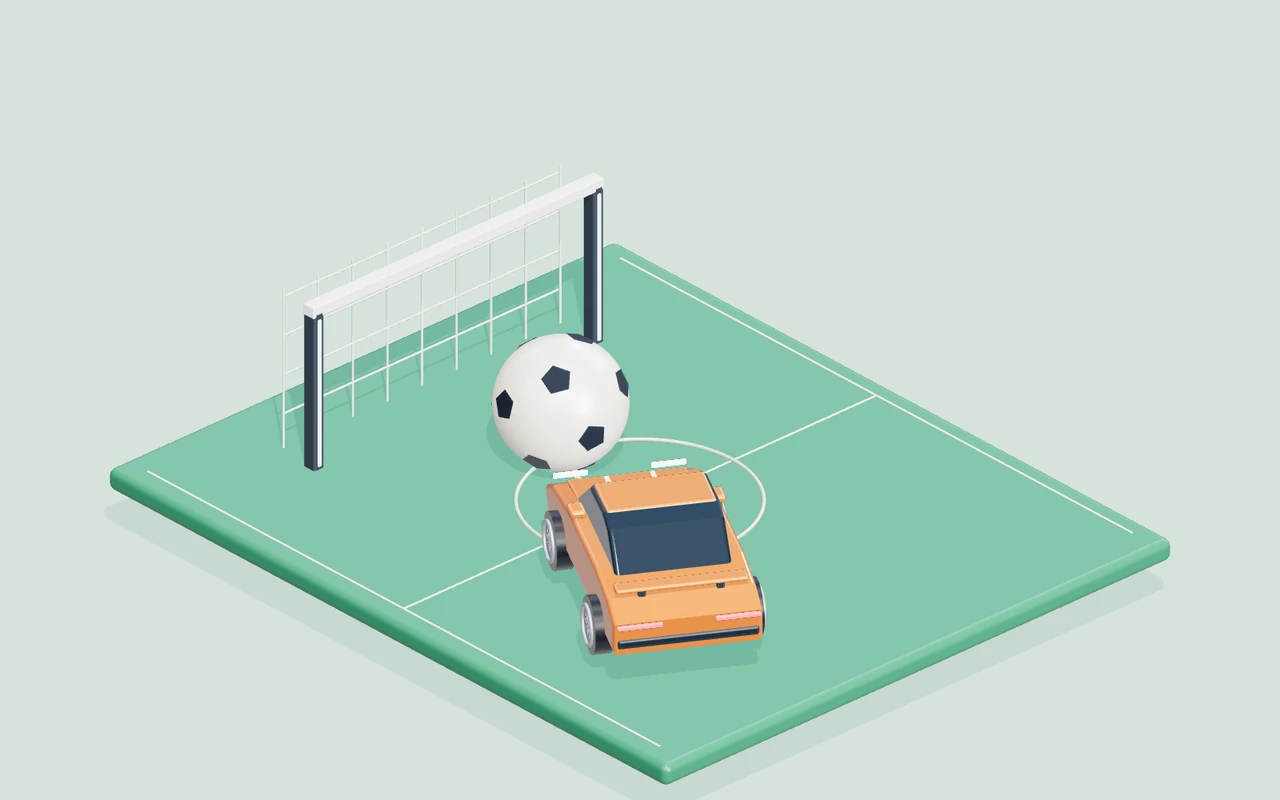
Driving straight at a football can produce a strong push without producing a useful shot. The ball’s path depends on where and how the car meets it, while the goalkeeper makes the central route an active challenge. Turbo Football becomes more interesting when you prepare an approach around the ball instead of treating it as an accelerator target. This article focuses on the contact angle: read the goal, move to a useful side and leave the car able to follow the result. It describes the game’s physical ball and reactive keeper rather than promising an exact football technique or a guaranteed goal.
Read the goalward line: The car is not the scoring object
The car creates contact, but the ball must travel through the goal condition. Before pushing, look at the ball’s position relative to the goal and goalkeeper. Then decide where the vehicle should meet the ball to create a useful outgoing line.
A straight approach from the car’s current position may not match that goalward direction. If it would push the ball across the field, reposition first rather than compensating with more speed. Use the supported pitch to choose a clearer side of contact. You do not need an exact aiming overlay to learn this relationship; the ball’s resulting path supplies evidence. Keep the goal in the question instead of judging a shot only by how far the ball moves after a dramatic impact.
Approach from a useful side: Position before power
A contact from one side of the ball can redirect it differently from a centred push. That makes position an important part of the attempt. If you rush toward whichever surface is nearest, the car can meet the ball before the intended line is prepared.
Begin with a manageable approach and use the pitch to get behind or beside the ball in a way that serves the goalward path. Release large steering inputs before the contact when possible, so you can see the heading that actually meets the ball. More speed can strengthen a poor direction as easily as a useful one. Practise the contact position first. Once the outgoing path is understandable, test pace separately and observe whether it helps the same line rather than replacing an unclear approach with a harder collision.
Read the goalkeeper’s response: Keep an alternative in mind
The goalkeeper reacts to the play, so the line that looks open during preparation may change by the time the ball arrives. Watch its position alongside the intended path. A route through the central area can become easier to defend than one prepared toward a different part of the goalward space.
Use the response as information for the next contact, not as a reason to repeatedly hit the same line harder. If a familiar approach keeps sending the ball toward the keeper, change the contact angle or preparation position while keeping pace manageable. The game does not offer guaranteed precision from a real-world free-kick formula. Its useful challenge is reading a physical ball and a moving defender. A changed approach should have a visible purpose, such as producing a different ball line, rather than being another hopeful burst in the same direction.
Follow the result without chasing blindly: Prepare the next contact
After an impact, the ball can rebound or travel into a new position. The car’s path also matters, because a poorly controlled follow-through can leave it unable to prepare the next touch. Read the result before immediately holding the same direction again.
If the ball remains playable, reposition for another useful contact. If a goal is recognised, observe the game’s next ball state and mission progress before repeating the opening. Car recovery and ball reset are separate actions, so use the control that answers the actual problem. A vehicle in an awkward position does not necessarily mean the ball needs a reset. An unhelpful ball location does not automatically mean the whole mission must start again. Keep the next attempt focused on the object and condition that needs attention.
A strong push goes across the goalward route
You meet the ball from the nearest side and produce obvious movement. It travels across the field rather than toward the useful scoring line, so the strength of the impact does not create the result you expected. Reposition and read the ball relative to the goal before the next contact. Choose a side that gives the push a clearer outgoing direction, and use a manageable approach while learning that relationship.
Watch the ball’s path after impact, not only its speed. A more useful direction is evidence that the contact position improved, even if the goalkeeper still prevents the attempt from becoming a goal. Preserve the clearer angle before adding more pace. More force along the same poor line does not solve the earlier positioning problem, and it can leave both objects harder to approach for another touch.
The keeper repeatedly meets the same line
Several attempts send the ball along a familiar central path toward the goalkeeper. You respond by using longer acceleration, while the contact position and direction remain nearly unchanged. Change the preparation angle rather than only the impact strength. Read the keeper and goalward space, choose a different useful side of the ball and keep the approach pace similar for the comparison.
Notice whether the ball now travels through a different part of the scoring space. The keeper’s response gives feedback about that line, while one successful or blocked attempt cannot promise the same outcome every time. Use the changed path to decide the next adjustment. Keep a useful angle if it creates an alternative, then refine pace separately instead of returning to a harder version of the same predictable central push.
The car cannot follow a promising contact
Your ball line looks useful, but the vehicle carries past the play with a large heading change. By the time you turn back, the ball’s new position requires another hurried approach and the next contact loses the earlier preparation. Use a more manageable approach and release unnecessary steering before contact. Read where the car should remain after meeting the ball so you can prepare another touch if the first does not score.
Compare the vehicle’s position after impact as well as the ball’s line. A useful follow-through leaves the car able to interpret the next ball state instead of chasing from an awkward angle. Keep the approach that supports another deliberate contact. A physical football attempt can need several readable touches; a dramatic first hit is less useful if it removes your ability to prepare the following one.
An awkward vehicle is confused with an awkward ball
The car becomes poorly positioned while the ball remains in a reasonable part of the pitch. You reset the ball or restart the whole run because the next approach feels inconvenient, losing the chance to examine that position. Identify which object needs help. Use vehicle recovery for an awkward car, or the separate ball action when the ball’s state is the actual problem. Read the current controls before assuming the two resets do the same thing.
Watch the ball and mission progress after the chosen action. The useful reset should answer the specific obstacle to your next contact rather than replace the entire experiment without a clear reason. Prepare the next angle from the recovered state and compare the contact decision again. Choose a fresh run when you want the original opening, not as the only response to every inconvenient position on the pitch.
Keep the experiment useful: Controls, recovery and setup
Before trying the exercise, confirm the current mission in Turbo Football: Drive the ball past a moving goalkeeper and score three goals. The player’s controls table is the reference for the actual actions available. W / ↑ means accelerate. S / ↓ means brake; keep holding to reverse. A / D means steer. Start and focus the canvas before using the keyboard. On a phone, use the labelled touch actions under the scene. Change one input at a time while learning the response; unfamiliar finger placement can otherwise look like an unexplained change in the game’s handling.
Difficulty and Graphics answer different questions. Low creates a calmer learning condition by changing the relevant mission settings; Medium removes some assistance; High uses the base challenge. Changing difficulty begins a fresh run, so choose it before comparing attempts. Graphics changes the rendered scene: Low reduces resolution and disables sunlight shadows, Medium adds shadows, and High increases sharpness, shadow detail and material reflections. A clearer picture can help you read the scene, but it does not replace the movement decision described in this article. Keep difficulty fixed while testing a technique.
Three lives give a run room to continue after detected failure. Read the reason on the Continue panel and choose one correction before recovering. Continue restores a safe position while completed mission objectives remain where the mode supports them. Reset vehicle can recover an awkward position without refreshing the page or spending a life. Recovery does not mean a completely fresh mission: choose Start a new run when you want the original opening. A paused panel stops the active simulation, and a voluntary reset adds no time penalty.
Use the pause control if you need to read, change hand position or look away. Sound and background music have separate controls and begin after an interaction; they are optional feedback rather than prerequisites for understanding the visible target. Fullscreen gives the scene more room, with an expanded-player fallback where the native API is unavailable. If your experiment is about steering or timing, keep the browser, input arrangement and graphics profile consistent. A score from one isolated attempt tells you less than a decision that leaves the vehicle well positioned in several attempts.
Decisions at a glance
| Situation | Useful action | Evidence to watch |
|---|---|---|
| A strong push goes across the goalward route | Reposition and read the ball relative to the goal before the next contact. Choose a side that gives the push a clearer outgoing direction, and use a manageable approach while learning that relationship. | Watch the ball’s path after impact, not only its speed. A more useful direction is evidence that the contact position improved, even if the goalkeeper still prevents the attempt from becoming a goal. |
| The keeper repeatedly meets the same line | Change the preparation angle rather than only the impact strength. Read the keeper and goalward space, choose a different useful side of the ball and keep the approach pace similar for the comparison. | Notice whether the ball now travels through a different part of the scoring space. The keeper’s response gives feedback about that line, while one successful or blocked attempt cannot promise the same outcome every time. |
| The car cannot follow a promising contact | Use a more manageable approach and release unnecessary steering before contact. Read where the car should remain after meeting the ball so you can prepare another touch if the first does not score. | Compare the vehicle’s position after impact as well as the ball’s line. A useful follow-through leaves the car able to interpret the next ball state instead of chasing from an awkward angle. |
| An awkward vehicle is confused with an awkward ball | Identify which object needs help. Use vehicle recovery for an awkward car, or the separate ball action when the ball’s state is the actual problem. Read the current controls before assuming the two resets do the same thing. | Watch the ball and mission progress after the chosen action. The useful reset should answer the specific obstacle to your next contact rather than replace the entire experiment without a clear reason. |
YOUR NEXT SESSION
Put it into practice
Look at the ball, goal and keeper before touching the accelerator. Choose a contact side that should create a useful goalward line and approach at a manageable pace. After impact, read both the ball’s path and the car’s position for another touch. On the next attempt, change the contact angle while keeping pace similar. Use the keeper’s response as information, without promising a goal from one particular line. If the position becomes awkward, decide whether the car, ball or whole opening needs a reset before choosing the relevant action.
Play Turbo FootballFrequently asked questions
Is the fastest collision the best shot?+
Not necessarily. The outgoing ball path matters more than the drama of the impact. Prepare a contact position that serves a useful goalward line, then test pace separately. A stronger push in an unhelpful direction can make the next touch harder to prepare.
Can I guarantee a goal by aiming away from the keeper?+
No. The ball and goalkeeper interact during play, and the route can change between preparation and arrival. Use a different contact angle as a testable alternative. Observe the resulting line and keeper response rather than treating one technique as a guaranteed scoring formula.
Are vehicle recovery and ball reset the same action?+
They address different objects. Read the current controls and identify which position is blocking your next useful contact. Recovering an awkward car does not require resetting a playable ball, and choosing a fresh run restores a broader opening than either targeted action.
Final words
A football contact starts with the side of the ball you choose. Prepare a goalward angle, read the keeper and leave the car able to follow the result. A stronger push is useful only when its direction already answers the scoring problem.
Choose one idea from this article, try it in your next run, and notice what changes. A calmer, repeatable attempt gives you something useful to build on.