The jump is the visible highlight of Bike Motocross, but the landing explains whether that jump helped the route. A bike that reaches the next section with an extreme angle can lose the chance to continue, even after an impressive flight. This game uses a powered rear wheel, a physical chassis and lean controls in a side-view 3D course. It does not offer unrestricted steering, gears or a separate trick system. This guide focuses on preparing the next supported contact: read the slope before leaving, choose a deliberate hop where needed and use small pitch corrections you can observe. The aim is a flowing continuation rather than the biggest airborne movement.
Read the slope before launch: The next surface sets the question
Before adding a hop or a strong lean input, look at the surface the bike is likely to meet. A rise, a descent and the far side of a gap create different arrival conditions. The useful target is room for the wheels and a manageable chassis angle, not simply maximum height above the course.
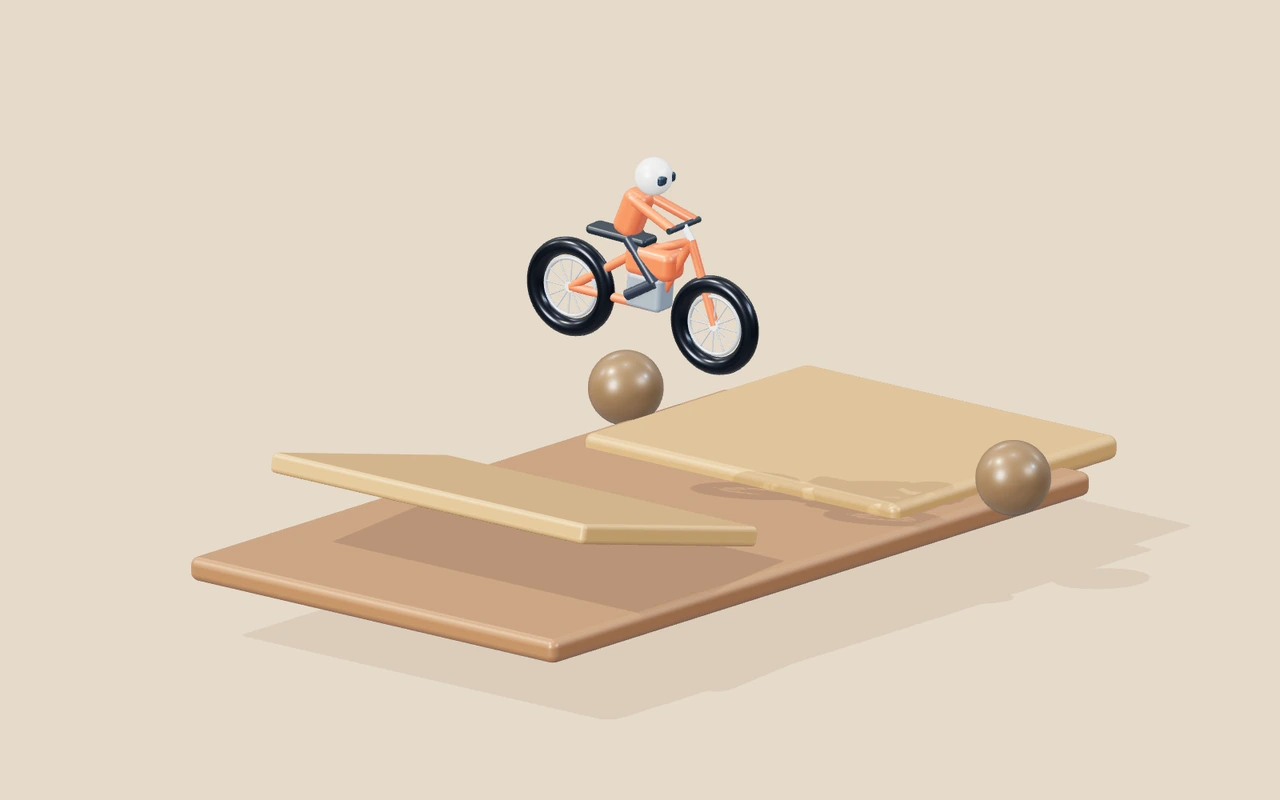
Let an early ramp show how ordinary throttle changes the bike’s motion. A supported ride over that ramp can teach you about pitch without introducing an extra launch at the same time. Once the response is readable, a deliberate grounded hop becomes another controlled question. Use the side view to connect departure and destination rather than treating the skyline as the target. It provides scenery and a sense of height, while the dirt surface and wheels provide the evidence for the landing. A clear picture of that next support makes a small correction easier to choose.
Prepare a supported departure: A late press cannot create a rescue hop
The hop needs wheel support and an available cooldown. Press before the bike loses the takeoff surface, while forward movement still carries toward the intended landing. Waiting until the bike is already falling into the gap cannot create a new supported launch.
Keep the departure understandable: approach with manageable throttle, choose the hop moment and release the action after takeoff. Holding the button indefinitely can make later supported behaviour harder to separate from the first intention. If a flight falls short, inspect whether the launch occurred while supported and whether the approach carried useful movement. Do not automatically answer every short landing with a longer backward lean. Lean changes chassis attitude; it is not a substitute for the support and movement needed at departure. A purposeful hop starts a flight you can evaluate, while a desperate press after support disappears provides little information about a useful takeoff.
Correct the visible pitch: Short input leaves room to observe
A and D apply backward and forward lean to the bike. Use the actual chassis angle as the reason for a correction. A long hold can carry the pitch beyond what the approaching surface needs, particularly when you are reacting to a remembered mistake instead of the visible current flight.
Try a brief correction and release so you can see its effect. If the front is dropping toward an unhelpful contact, inspect whether a small change improves the relationship of both wheels to the surface. If the angle already appears usable, avoid adding movement simply because the bike is airborne. Passive balance assistance gives the game a more manageable baseline, but it does not make excessive lean harmless. The useful lesson is an observable relationship between input and pitch. That relationship becomes harder to learn when the direction stays held through takeoff, the entire flight and the following touchdown.
Continue after contact: The finish still needs ground support
A promising flight becomes useful when the bike settles onto the route and can continue upright. Watch both wheels and the supported dirt section after arrival. Let the result become clear before adding another large throttle, lean or hop sequence.
The finish requires grounded progress at the end of the route. Passing the finish distance while falling or flying beyond support is incomplete. Keep reading the final surface even when the distance display suggests the goal is close. If a failed landing consumes a life, Continue gives another attempt from safe recovery; choose one change before resuming. A fresh run is useful when you want to connect the earlier slopes with the central gap and finish. Treat each as a supported transition. The dirt course is a flowing sequence, yet its rhythm becomes more enjoyable when each landing leaves the next action available instead of requiring an immediate rescue.
Every early ramp becomes an extra jump
You add a hop whenever the course rises. The bike spends more time airborne, but the following pitch and touchdown become difficult to read because throttle, slope and extra lift all change together. Ride one familiar early ramp with normal throttle first. Observe the bike’s departure angle and return to support, then add a deliberate hop on a later attempt while keeping the approach similar enough to compare.
Watch how the added hop changes flight time and the relationship to the next slope. Extra height is useful only if it leaves a manageable landing; it does not automatically improve a section that was already supported and readable. Keep the simple version where it works and reserve a hop for a clear purpose. The course can flow through ordinary ramps while still asking for a deliberate launch at the actual gap.
The hop button is pressed after support disappears
The front wheel has already left the departure lip when you decide the gap looks larger than expected. You press or hold hop while the bike is falling, but no new grounded impulse solves the flight. Recover and make departure timing the next question. Begin the hop while wheel support still exists, with enough approach movement to carry toward the far surface, and release after the intended launch.
Read the upward response at takeoff and the wheel path toward the destination. That evidence separates a supported launch from a late airborne press that never had the condition needed for a fresh hop. Adjust the supported approach or departure moment if the flight remains short. Avoid treating more held lean as a replacement for missing launch support, because pitch and the start of the jump answer different problems.
A long lean turns a useful flight into a poor arrival
The bike clears the gap, but a backward or forward input stays held while you watch the height. By the time the wheels approach the dirt, the chassis angle is less useful than it was earlier in the flight. Use one brief pitch correction and release. Compare the visible angle to the surface ahead, and allow the bike to show the result before pressing again or continuing the same direction through touchdown.
Watch whether both wheels approach support with a more manageable relationship. The important comparison is the arrival angle and continuation, not merely whether the rider appears higher or the flight lasts longer. Preserve the small correction if it helps, then keep the next throttle phase calm until support is clear. Repeating a stronger hold can undo the improvement by adding unnecessary rotation after the useful adjustment.
The finish distance is crossed without a supported landing
The distance display reaches the end while the bike is still airborne or descending beyond the available dirt. You expect completion immediately, but the supported finish condition has not been satisfied. Prepare the final section as another landing instead of a distance-only sprint. Read the available surface, use a manageable approach and let the wheels return to support before carrying upright movement through the finish.
Compare the distance indication with visible ground contact and the final result. An airborne coordinate alone is not the mission outcome; the landing must leave the bike supported at the completed route. On a fresh run, connect this final transition with the gap routine that worked earlier. Preserve the idea of riding toward the next support all the way to the end, rather than abandoning it as soon as the counter becomes promising.
Keep the experiment useful: Controls, recovery and setup
Before trying the exercise, confirm the current mission in Bike Motocross: Ride the dirt jumps and land upright on your way to the 130-metre finish. The player’s controls table is the reference for the actual actions available. W / GAS means drive the rear wheel. S / BRAKE means brake the rear wheel. A / D means lean backward / forward. Start and focus the canvas before using the keyboard. On a phone, use the labelled touch actions under the scene. Change one input at a time while learning the response; unfamiliar finger placement can otherwise look like an unexplained change in the game’s handling.
Difficulty and Graphics answer different questions. Low creates a calmer learning condition by changing the relevant mission settings; Medium removes some assistance; High uses the base challenge. Changing difficulty begins a fresh run, so choose it before comparing attempts. Graphics changes the rendered scene: Low reduces resolution and disables sunlight shadows, Medium adds shadows, and High increases sharpness, shadow detail and material reflections. A clearer picture can help you read the scene, but it does not replace the movement decision described in this article. Keep difficulty fixed while testing a technique.
Three lives give a run room to continue after detected failure. Read the reason on the Continue panel and choose one correction before recovering. Continue restores a safe position while completed mission objectives remain where the mode supports them. Reset vehicle can recover an awkward position without refreshing the page or spending a life. Recovery does not mean a completely fresh mission: choose Start a new run when you want the original opening. A paused panel stops the active simulation, and a voluntary reset adds no time penalty.
Use the pause control if you need to read, change hand position or look away. Sound and background music have separate controls and begin after an interaction; they are optional feedback rather than prerequisites for understanding the visible target. Fullscreen gives the scene more room, with an expanded-player fallback where the native API is unavailable. If your experiment is about steering or timing, keep the browser, input arrangement and graphics profile consistent. A score from one isolated attempt tells you less than a decision that leaves the vehicle well positioned in several attempts.
Decisions at a glance
| Situation | Useful action | Evidence to watch |
|---|---|---|
| Every early ramp becomes an extra jump | Ride one familiar early ramp with normal throttle first. Observe the bike’s departure angle and return to support, then add a deliberate hop on a later attempt while keeping the approach similar enough to compare. | Watch how the added hop changes flight time and the relationship to the next slope. Extra height is useful only if it leaves a manageable landing; it does not automatically improve a section that was already supported and readable. |
| The hop button is pressed after support disappears | Recover and make departure timing the next question. Begin the hop while wheel support still exists, with enough approach movement to carry toward the far surface, and release after the intended launch. | Read the upward response at takeoff and the wheel path toward the destination. That evidence separates a supported launch from a late airborne press that never had the condition needed for a fresh hop. |
| A long lean turns a useful flight into a poor arrival | Use one brief pitch correction and release. Compare the visible angle to the surface ahead, and allow the bike to show the result before pressing again or continuing the same direction through touchdown. | Watch whether both wheels approach support with a more manageable relationship. The important comparison is the arrival angle and continuation, not merely whether the rider appears higher or the flight lasts longer. |
| The finish distance is crossed without a supported landing | Prepare the final section as another landing instead of a distance-only sprint. Read the available surface, use a manageable approach and let the wheels return to support before carrying upright movement through the finish. | Compare the distance indication with visible ground contact and the final result. An airborne coordinate alone is not the mission outcome; the landing must leave the bike supported at the completed route. |
YOUR NEXT SESSION
Put it into practice
Choose an early ramp and observe a normal throttled departure before adding a hop. On the next attempt, compare one supported launch with that baseline. During flight, use at most a small deliberate pitch correction, release and inspect the wheels relative to the next surface. At the central gap, make launch support the first question and angle the next one. Finish by watching the final dirt contact rather than only the distance. After a failed landing, name one change on the Continue panel and use the next life to test it.
Play Bike MotocrossFrequently asked questions
Can I steer sideways around a difficult ramp?+
The 3D scene uses a side-view movement plane. A and D lean the chassis rather than changing lateral lanes. Use throttle, supported hop and pitch preparation for the course that is actually present; there is no free-direction bypass around the dirt route.
Should I hold lean throughout every jump?+
A held input continues to affect pitch and can create an excessive arrival angle. Try a brief correction only when the visible chassis and approaching surface give it a purpose, then release and observe. An already usable flight may need no additional correction.
Why is the final airborne distance incomplete?+
The finish expects upright, grounded progress. Reaching its horizontal distance during a flight or fall does not supply the missing support. Prepare the last dirt contact and continue while supported instead of judging completion from the distance display alone.
Final words
Prepare the surface you want to meet. A supported departure gives the jump a useful beginning, and a small visible pitch correction can improve its arrival. Keep reading ground contact through the final metres so the flight leaves a playable continuation.
Choose one idea from this article, try it in your next run, and notice what changes. A calmer, repeatable attempt gives you something useful to build on.