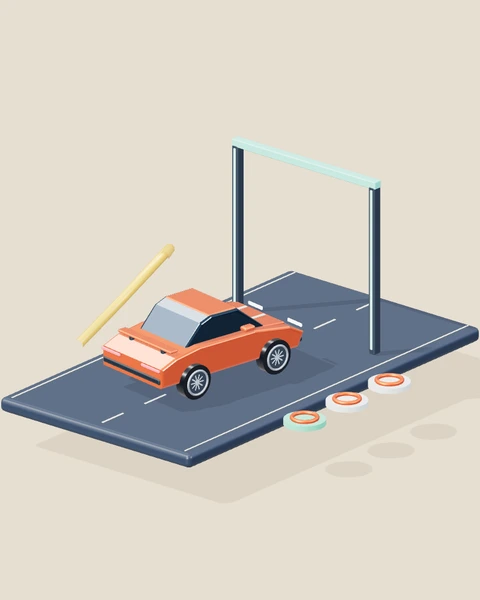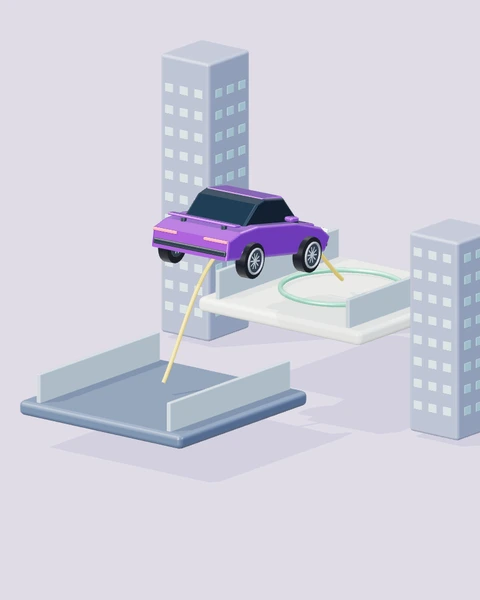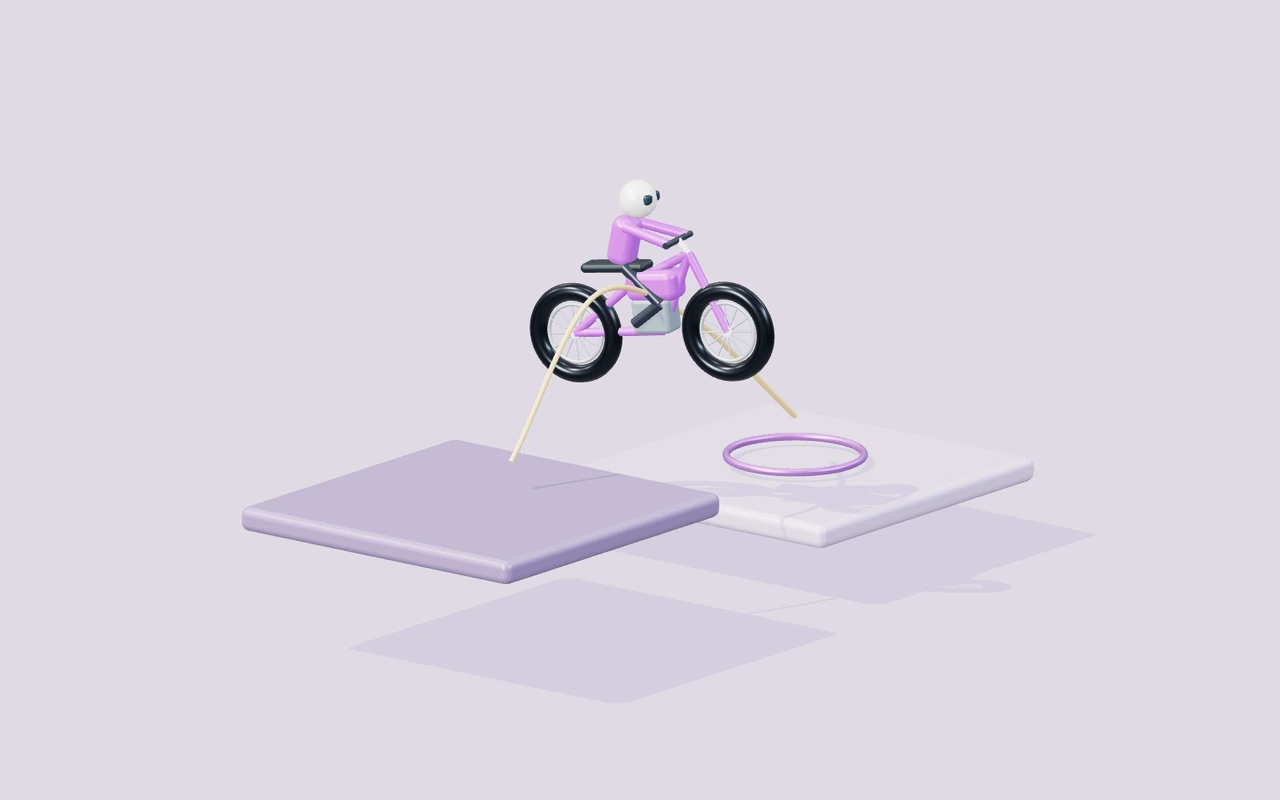
Both bike games use a rear-wheel motor, a physical chassis and a side-view camera, but their courses ask for different planning. Motocross connects ramps with a central dirt gap. Trials separates six rooftop pads with changing heights. In both, a hop begins while supported; once falling, holding the button cannot invent another surface beneath the wheels.
Approach before you hop
A stationary hop adds height without enough forward movement to cross a gap. A fast approach can consume the supporting surface before you launch. Use a departure point that leaves wheel contact and a little forward speed.
In Trials, HOP markers identify preparation areas before pad edges. The slower motor gives time to judge that point. Motocross slopes can already create airborne motion, so adding a hop changes an existing takeoff rather than replacing the need to read the ramp.
Support and cooldown are real conditions
Space works when the wheels have contact and the hop cooldown has recovered. A brief press and release is easier to assess than holding through several landings, where another hop can trigger once conditions return.
If the bike reaches a raised pad’s face with the rear wheel still below the lip, inspect launch timing and approach speed. More backward lean does not create the missing upward clearance. Try to arrive on the top surface with room for the rear wheel to follow.
Use lean to settle attitude
A and D apply backward or forward lean to the tilting chassis. Small corrections help bring the nose toward a useful landing line. A long hold can tilt too far and consume a life, even with passive stabilisation.
The side-view movement plane keeps that angle readable. These are 3D models and physical wheel interactions, but not free-direction motorcycle simulations. Watch the visible frame angle and BALANCE display together, then release a correction before it turns into another problem.
Rising and descending pads need different arrivals
Trials first climbs onto higher roofs, then drops toward lower ones. A higher destination gives less time before a near-face collision; a lower destination can extend the fall. One unchanged hop rhythm is therefore not an ideal answer to all five gaps.
A supported reached pad creates a recovery point within the attempt. Passing a coordinate while falling does not. At either finish, ground contact still matters: 91 metres in Trials and 130 in Motocross. Passing the distance in the air is not the same as arriving upright on the final surface.
Decisions at a glance
| Observation | Question for the next attempt |
|---|---|
| Hop never starts | Were wheels supported and cooldown ready? |
| Rear hits the near face | Was launch late enough with enough clearance? |
| Nose rotates too far | Was lean held after it was useful? |
| Finish distance passed in air | Can the landing settle on the final pad? |
YOUR NEXT SESSION
Put it into practice
In Trials, practise the first gap with a short hop press. Compare where the rear wheel lands, then alter departure slightly while preserving speed. In Motocross, ride the first rise without a hop to learn its natural pitch before trying the marked central gap.
Play Bike TrialsFrequently asked questions
Can I complete the route with throttle alone?+
The pads are separated by real gaps and raised lips. The intended approach combines forward movement with grounded hops before their edges. Simply holding throttle tends to lose support or hit a destination face.
Are all five hops identical?+
No. The route first climbs and then descends, so the available landing time and target height change. Use the next pad’s lip and surface as references rather than copying one timing without observing its result.
When does a checkpoint become safe?+
A reached pad needs supported movement before it becomes a recovery point. Passing a horizontal coordinate while falling does not secure it. After a failure, recovery places the bike slightly inside the reached pad.
Final words
Prepare support and movement before launch, then use lean for attitude. Those are separate parts of a useful landing.
Choose one idea from this article, try it in your next run, and notice what changes. A calmer, repeatable attempt gives you something useful to build on.