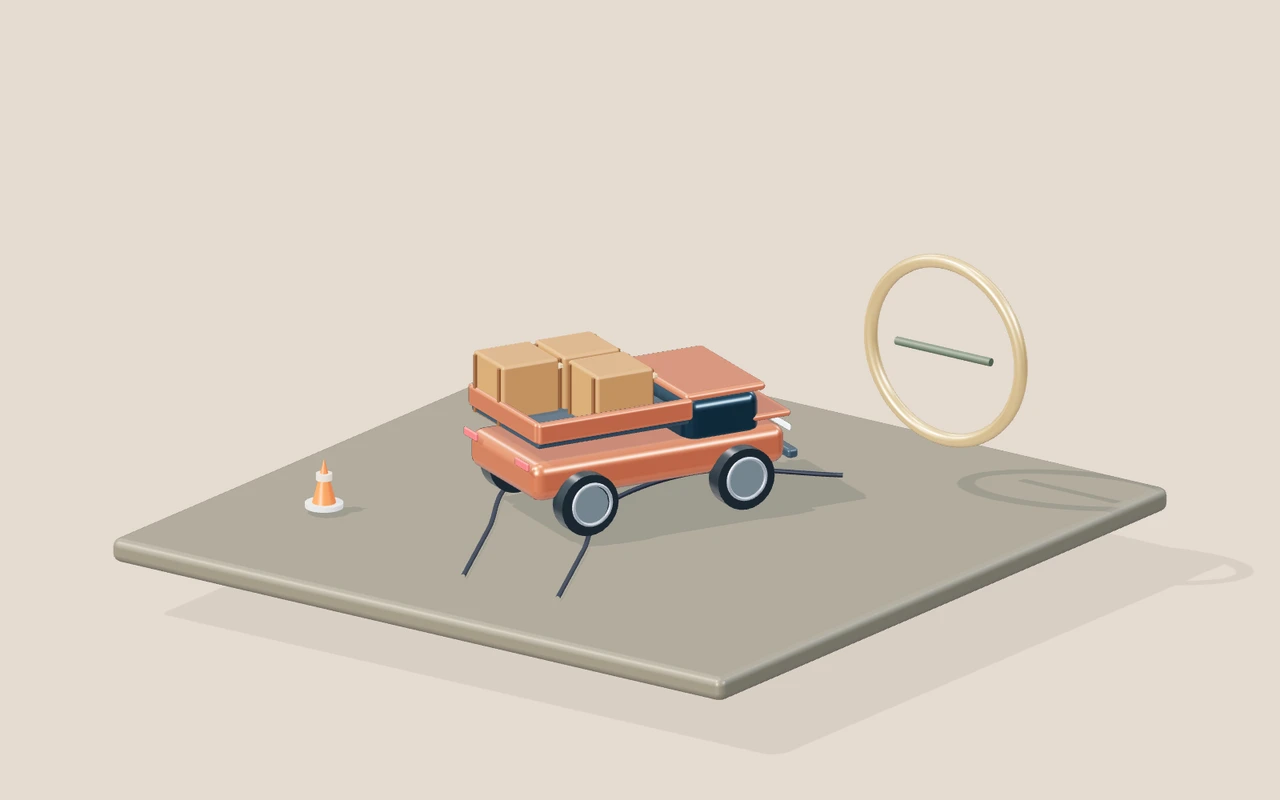
Loose cargo makes the rear bed part of your control problem. The truck can follow a road while the boxes slide or tip in response to its movement. Cargo Balance asks you to preserve all three through a winding harbour route, then stop on the delivery pad. Smooth movement matters throughout the route, not only when the final marker appears.
Make the departure a load check
The initial bed has low supporting walls and three separate crates. Accelerate along the broad start pad and watch for movement between them. A little shifting is possible without losing the load; the live count reports whether the boxes remain sufficiently close above the chassis.
Do not confuse the objects with a fixed inventory. Once a crate leaves the truck after setup, the delivery attempt ends. There is no roadside recollection action. A full restart restores the complete load and lets you try another approach.
Brake while the truck is still straight
Reduce speed before the marked direction change, turn on the road’s outgoing line and restore throttle after alignment. Braking and large steering at the same time can disturb the boxes while also leaving the bed outside the road edge.
Use the next section of road as the reference, not just its ring marker. The four route points must be reached in order, and the connecting raised surface is the available support. The front of the pickup can follow a line that leaves the rear bed too far outward during a long turn.
A stable arrival is a second requirement
All four route points need to be recorded, but passing the final marker at speed does not finish the delivery. Remain near the pad centre, slow to a stop and hold briefly with all three crates still onboard.
Precision Parking has a different stopping problem: it checks three bay positions and heading alignment with a two-second hold. Cargo’s final pad uses its own proximity, movement and load rules. Shared low-speed controls do not make those completion tests interchangeable.
Diagnose the corner before changing the whole route
If the cargo fails near a waypoint, look at the preceding movement. The marker itself does not throw the boxes away. A faster turn, an abrupt reverse or repeated left-right corrections can all make the load unstable.
Repeat the same corner with earlier braking while keeping steering similar. If that preserves the load, extend the calm technique to the next bend. Later, shorten excessive stops one at a time. A consistent delivery is a better foundation than a fast opening followed by one irrecoverable spill.
Decisions at a glance
| Situation | Useful response |
|---|---|
| Approaching a bend quickly | Brake before turning |
| Bed swings outside the route | Shorten steering and reduce entry speed |
| Four points recorded, no result | Stop near final pad with all three crates |
| A box has left the bed | Restart with a complete load |
YOUR NEXT SESSION
Put it into practice
Drive only the opening pad and first bend. Note the cargo count after the turn. Repeat with an earlier brake application at a similar steering duration. Continue to the next route point only once that corner keeps all three crates consistently.
Play Cargo BalanceFrequently asked questions
Are the crates attached to the pickup?+
No. They are separate physical bodies supported by the bed and its low walls. They can shift, tip or fall during movement. Keeping all three onboard is a continuous mission requirement.
Why is the run unfinished after four route points?+
The final delivery also requires staying near the pad centre, slowing below roughly walking speed and holding still briefly with all crates preserved. Passing through the marker at speed is incomplete.
Can I pick up a fallen crate again?+
There is no collection mechanic for spilled cargo. After the opening settling interval, losing any crate ends the attempt. Restart provides a fresh truck and complete load for another route.
Final words
Cargo is a live physical condition. Preserve it during movement, then satisfy the separate stable-stop requirement at delivery.
Choose one idea from this article, try it in your next run, and notice what changes. A calmer, repeatable attempt gives you something useful to build on.