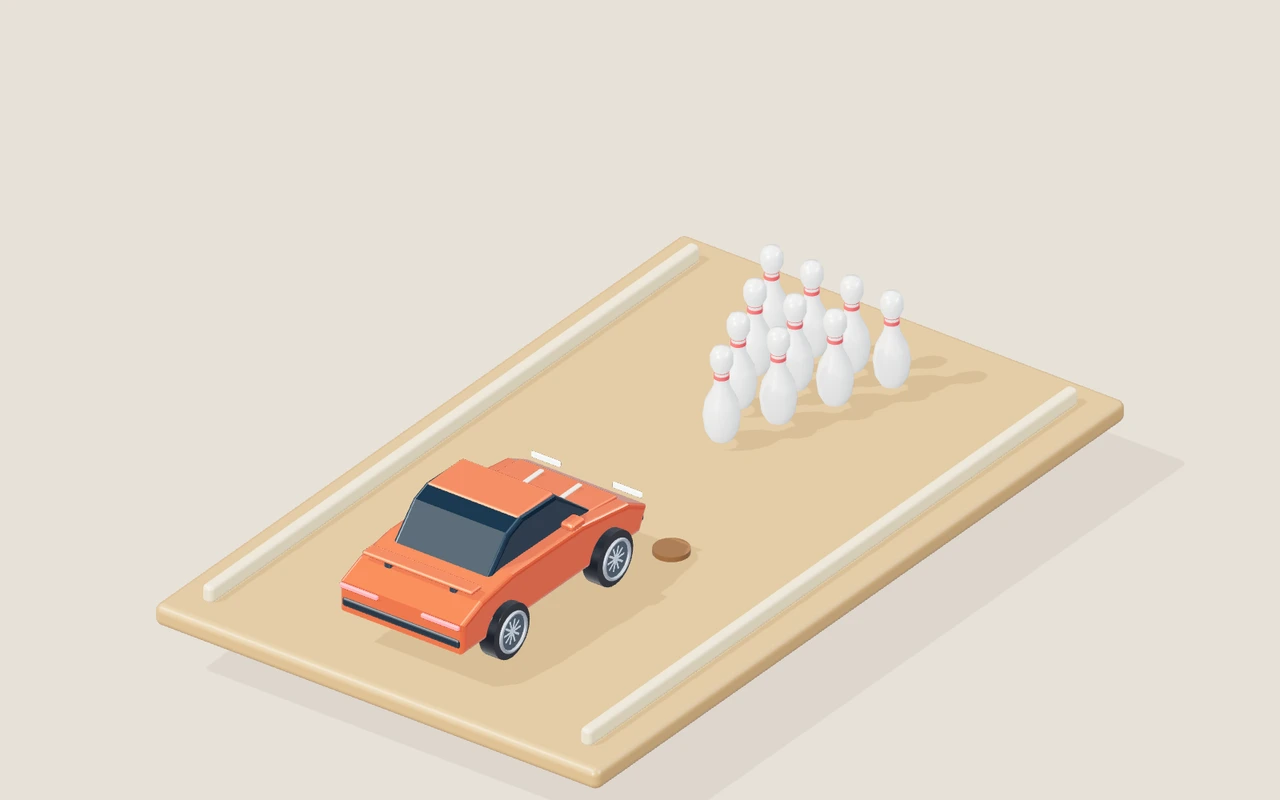
Stunt Bowling turns the car into an unusual launcher, but its real interest is what happens after the first impact. Ten independent physical pins can fall, move or remain standing in a new arrangement. The next shot therefore begins with information that the first shot did not have. A useful strategy combines a deliberate opening line with a cleanup plan for the leave. This article explains aiming, charge and persistent pins, then shows why a perfect first strike is only one possible route through the game. It also separates the three-shot budget from the three-life recovery system in the current edition.
A launch is a chosen line: Inspect the pin arrangement first
Before holding the charge control, look at the pins you want the car to contact. A centred launch is a useful baseline, but a slight angle can change which pins interact and where the car travels after impact. The aiming controls adjust that line before release.
Begin with a line you can describe. A small change is easier to investigate than sweeping across the full aim range and choosing a position at random. Watch how the car reaches the first pins and what the following contacts do. A launch is successful as an experiment when it teaches you about the path, even if it does not immediately clear all ten. That knowledge becomes especially valuable for the next shot, when the remaining arrangement can be much simpler.
Charge changes movement: Compare power without losing the aim
Holding the action builds charge; releasing it launches the car. More charge changes the launch movement, but it does not repair an aim line that misses the useful part of the pin group. The two decisions should be compared separately.
Choose a consistent line and make a moderate launch. Observe the pin contacts and remaining arrangement, then compare a different charge from a comparable opening setup in a fresh attempt. Avoid changing aim and power so dramatically that neither result explains the other. Within a continuing three-shot run, a weaker cleanup launch can also be useful if the remaining pin position does not need the same forceful opening contact. The point is purposeful movement, not holding every launch to maximum by habit.
Pins are physical: Wait for the result to settle
An impact can trigger several later contacts. A pin may tip after another one slides into it, or move before finally settling. Reading the leave too early can make you aim at a pin that is still about to fall. The game allows the launched shot to play out before presenting the next adjustment.
Use that interval to watch the interaction rather than immediately planning a button sequence for the next launch. Notice which pins remain upright and which are already moving away. The score reflects toppled pins rather than a promise that a particular line always produces a strike. Physics can create different leaves from nearby inputs, so a practical strategy needs to handle the observed arrangement, not only an ideal first-shot pattern.
The leave is new information: Build a cleanup decision
Pins remain in their changed state between shots. That persistence gives the second launch a different purpose from the first. You no longer need to attack a complete triangular group; you need a useful contact with whichever pins remain standing.
Identify a remaining cluster or isolated upright pin. Choose a line toward it and consider whether the car can reach more than one useful contact along that path. A broad first-shot line may be inappropriate for a single remaining pin near one side. Do not spend the next launch repeating the opening out of habit. The leave tells you what the new problem is, and the aiming control gives you a way to respond to it.
Three shots and three lives: Understand the two budgets
A bowling attempt has a three-shot launch sequence. If pins remain after that sequence, the current life can end and the recovery flow offers another opportunity while lives remain. Recovery resets the launch budget and restores a usable car setup; the pin arrangement continues to provide the cleanup problem for the run.
This should not be confused with a guarantee of clearing all ten pins. A legitimate three-shot outcome can leave pins standing, and a later life can also fail. Use the Continue screen to read the result before choosing another line. After all three lives, Play again creates a fresh run. The visible shot count and life indicators help you decide whether you are adjusting within the current sequence or starting another attempt at the remaining task.
Practice the first line and the cleanup separately: Build a flexible strategy
A good opening matters, but practising only complete first-shot strikes leaves you unprepared for an ordinary leave. Spend some attempts examining what different opening lines tend to leave, then practise responding to the actual remaining pins in the same run.
A useful record is brief: opening aim, approximate charge, remaining upright pins and the cleanup line you chose. The record should describe what you saw rather than invent a universal strike formula. Over time, you may recognise which lines give manageable leaves and which scatter the task into awkward corners. That is a better strategy than treating every result below ten as evidence that the game or the chosen input must be wrong.
Choose your pace: Difficulty and recovery
Start Stunt Bowling on Low while you learn its objective: Aim and launch your car to topple ten physical pins in three shots. Low is the default in this edition. For the new physical challenges it gives a larger time allowance and calmer handling; applicable courses also have wider landing surfaces or slower moving hazards. Medium sits between that assistance and the High challenge. The setting changes gameplay, while Graphics controls drawing quality. Keeping those decisions separate helps you answer the right question: is the task unfamiliar, or is the device struggling to draw it smoothly?
Each run begins with three lives. A detected failure uses one life and offers Continue from a safe checkpoint. The new vehicle challenges preserve completed objectives within the run; cargo recovery reloads the boxes, pursuit recovery restores shields, and bike recovery returns to a supported part of the course. After the last life, Play again starts a fresh run without reloading the page. Reset vehicle is also available for an awkward position. A voluntary reset does not need to become a repeated page refresh.
Changing difficulty starts a fresh run, because the layout and timing need to agree with the chosen setting. Your saved preference belongs to this browser and this game. Treat a comparison between Low and High as two different practice conditions, rather than evidence that the same score means the same performance. For a fair experiment, keep the difficulty, control method and starting checkpoint consistent. Increase the challenge after you can explain the action that reliably worked, instead of using a harder setting to compensate for a technique you have not yet understood.
Opening baseline: Keep the line readable
Ten pins stand in the initial arrangement, so the first launch can provide a reference for later aim and charge comparisons. Choose a modest, recognisable aim position and release a moderate charge. Watch the initial contacts rather than immediately changing the next input.
Note which part of the group was struck and which pins remain upright after the shot settles. A first leave is useful information. Use that observed leave for a cleanup plan. Compare a different opening only in a fresh run with the initial arrangement restored.
Power comparison: Keep aim steady
A nearby charge can change the movement through the pins while an entirely different angle makes the comparison harder to interpret. In a fresh opening setup, keep the aim similar and change charge moderately. Observe the car’s path and subsequent pin interactions.
Compare whether the extra movement helps contact useful pins or mainly carries the car beyond them. More power need not improve the leave. Keep the charge that produces a understandable result. Refine the angle separately when the remaining problem is clearly one of contact position.
One side remains: Aim at the actual cluster
After a shot settles, several upright pins may remain together on one side instead of around the initial centre line. Adjust the next launch toward that cluster. Choose a manageable charge that serves the new contact rather than repeating the opening automatically.
Watch whether the car reaches the remaining pins and whether their interactions create further useful contacts. The old centre is no longer the whole task. Use the cluster’s position to choose the line. A cleanup shot should answer the leave you have, not the initial arrangement you remember.
Isolated pin: Prefer a clear contact
One remaining upright pin can make a broad opening strategy wasteful. The useful path may be narrow but easy to describe. Aim toward the observed pin position and release a deliberate charge. Keep the direction decision clear before increasing launch movement.
Check whether the car’s path actually crosses the pin’s usable contact area. A near pass is a different result from a toppled pin. Correct the aim before assuming that maximum charge is necessary. The smaller task is often about alignment more than spectacle.
End of sequence: Plan the next opportunity
Three launches have completed while one or more pins remain. The life and recovery flow explain the next available attempt. Read the result, choose Continue while lives remain and inspect the preserved pin arrangement before preparing another launch.
Notice the difference between the refreshed launch budget and the ongoing task of clearing remaining pins. The screen should not require a page refresh. Use the next opportunity to test a chosen line. After the final life, begin a fresh run and apply what the earlier leaves taught you.
Decisions at a glance
| Situation | First decision | What to observe |
|---|---|---|
| Opening baseline · Keep the line readable | Choose a modest, recognisable aim position and release a moderate charge. Watch the initial contacts rather than immediately changing the next input. | Note which part of the group was struck and which pins remain upright after the shot settles. A first leave is useful information. |
| Power comparison · Keep aim steady | In a fresh opening setup, keep the aim similar and change charge moderately. Observe the car’s path and subsequent pin interactions. | Compare whether the extra movement helps contact useful pins or mainly carries the car beyond them. More power need not improve the leave. |
| One side remains · Aim at the actual cluster | Adjust the next launch toward that cluster. Choose a manageable charge that serves the new contact rather than repeating the opening automatically. | Watch whether the car reaches the remaining pins and whether their interactions create further useful contacts. The old centre is no longer the whole task. |
| Isolated pin · Prefer a clear contact | Aim toward the observed pin position and release a deliberate charge. Keep the direction decision clear before increasing launch movement. | Check whether the car’s path actually crosses the pin’s usable contact area. A near pass is a different result from a toppled pin. |
| End of sequence · Plan the next opportunity | Read the result, choose Continue while lives remain and inspect the preserved pin arrangement before preparing another launch. | Notice the difference between the refreshed launch budget and the ongoing task of clearing remaining pins. The screen should not require a page refresh. |
YOUR NEXT SESSION
Put it into practice
Make one opening launch and spend the settling interval identifying the leave. Choose a cleanup line toward the largest useful remaining target, then reassess before the third shot. In a fresh run, change only the opening charge and compare the leave. Record the pin positions you actually needed to solve rather than judging every attempt only by whether the first shot cleared ten. This builds a strategy that can adapt when the physical result is imperfect.
Play Stunt BowlingFrequently asked questions
Which game should I use for this practice?+
Use Stunt Bowling first: Aim and launch your car to topple ten physical pins in three shots. The article's examples are organised around its actual objective, rather than a generic racing score. Start with one exercise and a consistent difficulty, then try a related game when you can explain what changes between the two tasks.
Can I practise on a phone?+
The player provides touch controls beneath the scene, including the action buttons needed by Stunt Bowling. Use two comfortable fingers when actions must overlap. A keyboard offers a different physical arrangement, so allow a few attempts to learn the mobile timing instead of expecting identical finger movements. Keep the browser controls out of the way with fullscreen when that is more comfortable.
What should I do after a failure?+
Use Continue while lives remain. Read the visible reason first, because a missed landing, lost cargo or depleted shields asks for a different correction. After three lives, start a fresh run with Play again. Reset vehicle can recover an awkward position without refreshing the entire page. The browser retains preferences and available local records when storage is allowed.
Does the exercise promise a particular result?+
No. These are repeatable practice comparisons, not a guaranteed score or a real-world driving qualification. Timing, starting position and control method affect the result. Look for a reliable change in your decisions before treating a single good attempt as mastery. The game guide remains the place to check the complete mission rules and controls.
Final words
A useful bowling plan connects a chosen opening with an observed cleanup. Aim and charge are separate decisions, pins need time to settle, and persistent leaves make later shots meaningful. Three lives offer further attempts without promising a strike. Treat the remaining arrangement as the next problem to solve rather than a reason to repeat the same launch blindly.
Choose one idea from this article, try it in your next run, and notice what changes. A calmer, repeatable attempt gives you something useful to build on.